[et_pb_section admin_label=”section”][et_pb_row admin_label=”row”][et_pb_column type=”3_4″][et_pb_text admin_label=”Text” background_layout=”light” text_orientation=”left” use_border_color=”off” border_color=”#ffffff” border_style=”solid”]
I love China. I was on one of my early trips there, and the task was pretty straightforward: walk from my hotel to the nearest subway and ride it to my company’s office. I already knew that I couldn’t take a taxi in Beijing without being able to speak Chinese, but I wasn’t worried.
For taxis, foreigners usually need someone to write down the destination address in Chinese characters on a slip of paper to hand to the taxi driver. The drivers don’t read maps either, so pointing to a spot on one is fruitless. If they get lost, they call a buddy for help. Now there are apps to show the address in Chinese from your phone – but even the app isn’t always correct, as streets keep changing. I know; I have used an app and been taken to the wrong place more than once.
[/et_pb_text][et_pb_image admin_label=”Chinese you are here sign” src=”https://journeyswithstephen.com/wp-content/uploads/2015/09/Chinese-you-are-here-sign.jpg” alt=”Chinese you are here sign” title_text=”Chinese you are here sign” show_in_lightbox=”off” url_new_window=”off” use_overlay=”off” animation=”off” sticky=”off” align=”left” force_fullwidth=”off” always_center_on_mobile=”on” use_border_color=”off” border_color=”#ffffff” border_style=”solid”] [/et_pb_image][et_pb_text admin_label=”Text” background_layout=”light” text_orientation=”left” use_border_color=”off” border_color=”#ffffff” border_style=”solid”]
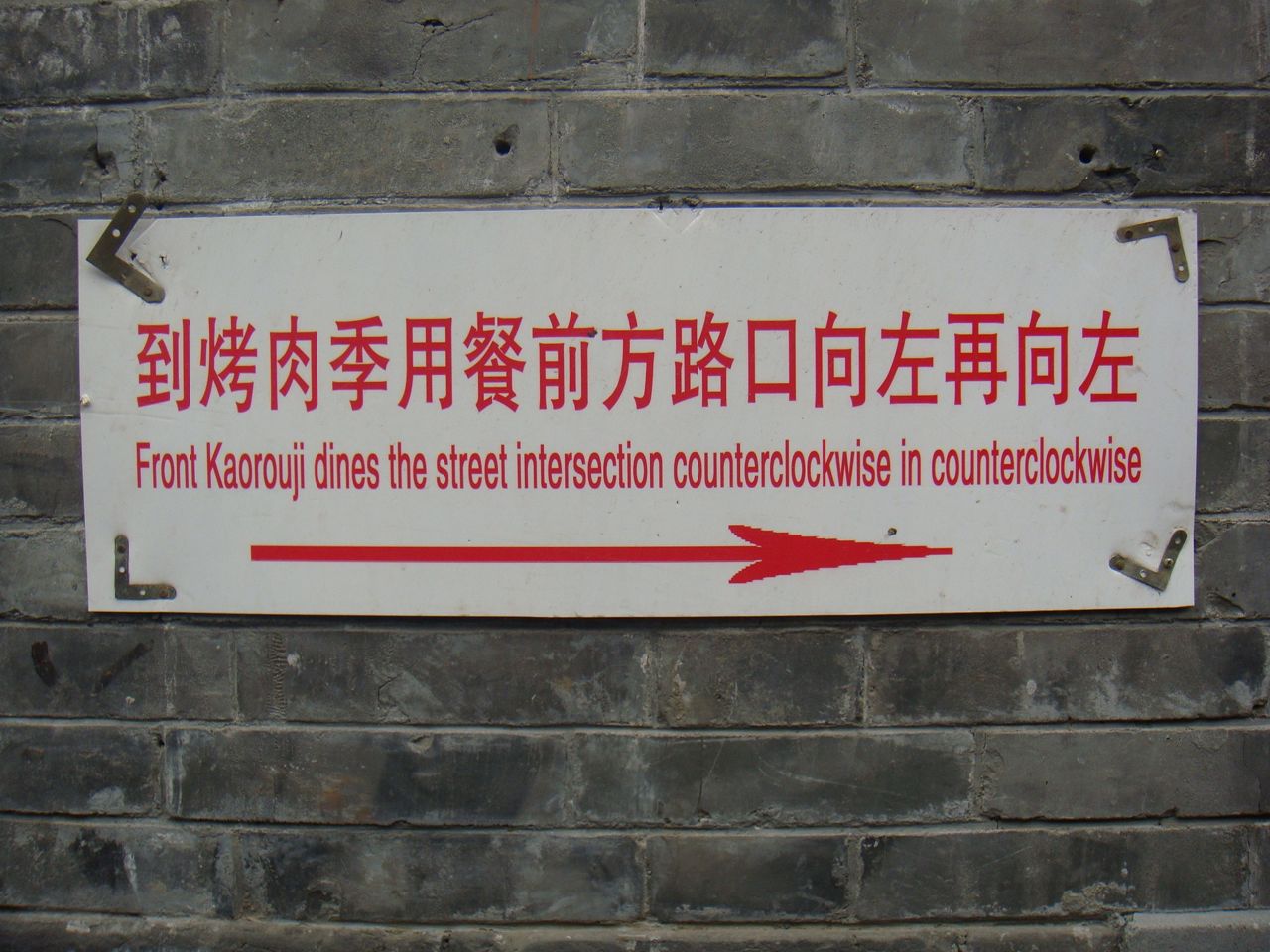
Fear not, I had been studying conversational Mandarin for a few months and could master some simple sentences in case I got lost. Which I did. My map, entirely in Chinese characters (which I don’t read), indicated the subway station should be close by, but I saw no signs. Of course the street signs are also only in Chinese, but I was looking for the little blue subway logo. Where was it?
As the mid-morning sun beat down on me in my dark suit and no longer crisp white shirt, I sought the answer. I would duck into the nearby air-conditioned department store and simply ask someone. And I knew how to say it! “Laojia, ditian zhan zai nar?” Literally, “Excuse me, subway station is where?”
[/et_pb_text][et_pb_image admin_label=”Beijing subway station sign” src=”https://journeyswithstephen.com/wp-content/uploads/2015/09/Beijing-subway-station-sign.jpg” alt=”Beijing subway station sign” title_text=”Beijing subway station sign” show_in_lightbox=”off” url_new_window=”off” use_overlay=”off” animation=”off” sticky=”off” align=”left” force_fullwidth=”off” always_center_on_mobile=”on” use_border_color=”off” border_color=”#ffffff” border_style=”solid”] [/et_pb_image][et_pb_text admin_label=”Text” background_layout=”light” text_orientation=”left” use_border_color=”off” border_color=”#ffffff” border_style=”solid”]
As expected, none of the sales clerks spoke English. What I didn’t expect was that no one understood a word I was saying. Should I speak more slowly? Louder? Use hand gestures?
Well folks, the culture shock we feel going to China versus most tourist spots in the world, is that you are truly illiterate. You can’t speak, listen, read, or write. And English really isn’t a second language, like in much of the Western world. Yes, kids study English in school and have to pass a test to get into college. But the emphasis is on reading and writing, and of course they forget even a lot of that over time. The average person simply does not speak a word of English.
The conversational difficulties are exacerbated by the Chinese tonal system. Every syllable essentially can be pronounced up to 4 different ways, yielding 4 different meanings. Hey, not that English is easy. Try saying this out loud: “Put some clothes on that animal. I can’t bear to see a bare bear!” We understand it because the words are in context.
[/et_pb_text][et_pb_image admin_label=”Chinese hair salon sign translated” src=”https://journeyswithstephen.com/wp-content/uploads/2015/09/Chinese-hair-salon-sign-translated.jpg” alt=”Chinese hair salon sign translated” title_text=”Chinese hair salon sign translated” show_in_lightbox=”off” url_new_window=”off” use_overlay=”off” animation=”off” sticky=”off” align=”left” force_fullwidth=”off” always_center_on_mobile=”on” use_border_color=”off” border_color=”#ffffff” border_style=”solid”] [/et_pb_image][et_pb_text admin_label=”Text” background_layout=”light” text_orientation=”left” use_border_color=”off” border_color=”#ffffff” border_style=”solid”]
Here I was in a department store, where they expected me to be asking for men’s clothing or shoes, and instead I was saying something else. Maybe the puzzled looks were just over a Caucasian speaking Chinese.
Finally, a customer who spoke some English interpreted my request. “Oh, you mean ditian (subway).” “Yeah, that’s what I’ve been saying.” It turns out that one of the many station entrances was less than 50 meters out the door. They pointed me in the right direction.
I’m not alone in discovering this culture shock. Deborah Fallows has written a fabulous book about it, “Dreaming in Chinese.” My favorite story was of her walking into a Taco Bell and asking if they have dabao (takeout). They were confused to have a lady asking for a “big hug” or a newspaper or if there was a hail storm outside. Oh well.
[/et_pb_text][et_pb_image admin_label=”Beijing subway route map” src=”https://journeyswithstephen.com/wp-content/uploads/2015/09/Beijing-subway-route-map.jpg” alt=”Beijing subway route map” title_text=”Beijing subway route map” show_in_lightbox=”off” url_new_window=”off” use_overlay=”off” animation=”off” sticky=”off” align=”left” force_fullwidth=”off” always_center_on_mobile=”on” use_border_color=”off” border_color=”#ffffff” border_style=”solid”] [/et_pb_image][et_pb_text admin_label=”Text” background_layout=”light” text_orientation=”left” use_border_color=”off” border_color=”#ffffff” border_style=”solid”]
I don’t mean to scare the first-time visitor. Actually, there is an alphabet-based equivalent to the Chinese characters, called pinyin, which helps. I wrote the Chinese sentence above, “Laojia, ditian zhan zai nar?” using pinyin. The subways in major cities list every stop in pinyin, and the nice lady on the speaker says them aloud in an English sentence. “Next stop Fuxingmen.” They are not hard to maneuver.
Even on an escalator you might hear the recorded voice say in English, “Please hold the handrail and get off” (in case you don’t know how to ride an escalator).
Big hotels usually have English-speaking staff who can help in numerous ways.
[/et_pb_text][et_pb_image admin_label=”Beijing menu sign mutton” src=”https://journeyswithstephen.com/wp-content/uploads/2015/09/Beijing-menu-sign-mutton.jpg” alt=”Beijing menu sign mutton” title_text=”Beijing menu sign mutton” show_in_lightbox=”off” url_new_window=”off” use_overlay=”off” animation=”off” sticky=”off” align=”left” force_fullwidth=”off” always_center_on_mobile=”on” use_border_color=”off” border_color=”#ffffff” border_style=”solid”] [/et_pb_image][et_pb_text admin_label=”Text” background_layout=”light” text_orientation=”left” use_border_color=”off” border_color=”#ffffff” border_style=”solid”]
And menus often have pictures, which we know are worth a thousand words that we can’t read. That’s a real help in China that I wish more countries would adopt. One time in Paris I thought I was ordering a veal chop in French, but wound up with a plate of calves’ brains. A picture would have helped a lot.
So, go with it. Language challenges are part of the adventure – and make for interesting tales to recount later.
This story is one that appears in the mini version of my upcoming eBook, Pearls of Wisdom about China. You can read some others simply by signing up below for the free newsletter.
[/et_pb_text][/et_pb_column][et_pb_column type=”1_4″][et_pb_text admin_label=”Text” background_layout=”light” text_orientation=”left” use_border_color=”off” border_color=”#ffffff” border_style=”solid”]
What’s upscale?
Staying at luxury Western hotels generally increases your chances of having English-speaking staff who can help translate (and gladly help you practice your Chinese).
What’s budget?
All those transportation methods. Taxis are usually reasonable in China and subways are downright cheap (and fun).
[/et_pb_text][et_pb_social_media_follow admin_label=”Social Media Follow” link_shape=”rounded_rectangle” background_layout=”light” url_new_window=”on” follow_button=”on” saved_tabs=”all”] [et_pb_social_media_follow_network social_network=”instagram” url=”http://www.instagram.com/journeyswithstephen” skype_action=”call” bg_color=”#517fa4″] Instagram [/et_pb_social_media_follow_network][et_pb_social_media_follow_network social_network=”twitter” url=”http://www.twitter.com/journeystephen” skype_action=”call” bg_color=”#00aced”] Twitter [/et_pb_social_media_follow_network][et_pb_social_media_follow_network social_network=”facebook” url=”http://www.facebook.com/journeyswithstephen” skype_action=”call” bg_color=”#3b5998″] facebook [/et_pb_social_media_follow_network] [/et_pb_social_media_follow][/et_pb_column][/et_pb_row][/et_pb_section]


 others there. Some questions asked to me and my answers: