Tag: temple

  • Chengde Mountain Resort is China’s secret

    Chengde Mountain Resort is China’s secret

    [et_pb_section fb_built=”1″ admin_label=”section” _builder_version=”4.16″ global_colors_info=”{}”][et_pb_row admin_label=”row” _builder_version=”4.16″ background_size=”initial” background_position=”top_left” background_repeat=”repeat” global_colors_info=”{}” column_structure=”3_4,1_4″][et_pb_column type=”3_4″ _builder_version=”4.16″ custom_padding=”|||” global_colors_info=”{}” custom_padding__hover=”|||”][et_pb_text admin_label=”Text” _builder_version=”4.16″ background_size=”initial” background_position=”top_left” background_repeat=”repeat” use_border_color=”off” border_color=”#ffffff” border_style=”solid” global_colors_info=”{}”]Mention the city of Chengde to Westerners and they reply, “Oh, the place with the pandas, right?” No, that’s Chengdu. Say “Chengde Mountain Resort,” and people assume it is a new hotel complex. No, it was built in the 1700s as a summer palace for the Qing emperors.
    [/et_pb_text][et_pb_image src=”https://journeyswithstephen.com/wp-content/uploads/2016/08/Prayer-bells-Putuo-Zongcheng-Temple-Chengde-China.jpg” alt=”Prayer bells Putuo Zongcheng Temple Chengde China” title_text=”Prayer bells Putuo Zongcheng Temple Chengde China” align_tablet=”center” align_last_edited=”on|desktop” admin_label=”Prayer bells Putuo Zongcheng Temple Chengde China” _builder_version=”4.16″ use_border_color=”off” border_color=”#ffffff” border_style=”solid” animation=”off” sticky=”off” always_center_on_mobile=”on” global_colors_info=”{}” align_phone=”center”][/et_pb_image][et_pb_text admin_label=”Text” _builder_version=”4.16″ background_size=”initial” background_position=”top_left” background_repeat=”repeat” use_border_color=”off” border_color=”#ffffff” border_style=”solid” global_colors_info=”{}”]Ask someone to find Chengde on a map, and they are surprised to see it is only about 250 km (155 miles) northeast of Beijing. Yet, I travel back and forth to Beijing for nearly 10 years before I ever set foot in Chengde. Why? Because it is one of China’s well-kept secrets.
    [/et_pb_text][et_pb_image src=”https://journeyswithstephen.com/wp-content/uploads/2016/08/Outlying-temple-Chengde-China.jpg” alt=”Outlying temple Chengde China” title_text=”Outlying temple Chengde China” align_tablet=”center” align_last_edited=”on|desktop” admin_label=”Outlying temple Chengde China” _builder_version=”4.16″ use_border_color=”off” border_color=”#ffffff” border_style=”solid” animation=”off” sticky=”off” always_center_on_mobile=”on” global_colors_info=”{}” align_phone=”center”][/et_pb_image][et_pb_text admin_label=”Text” _builder_version=”4.16″ background_size=”initial” background_position=”top_left” background_repeat=”repeat” use_border_color=”off” border_color=”#ffffff” border_style=”solid” global_colors_info=”{}”]Ask savvy travelers to list China’s UNESCO World Heritage Sites, and they will quickly name The Great Wall, Temple of Heaven, terracotta warriors and many others, without knowing that Chengde’s Mountain Resort and its Outlying Temples were recognized decades ago.

    Chengde gets so little respect that spell-check keeps telling me I have simply spelled Chengdu wrong. It is time for that to change. Starting here. So what are the rock stars of the Chengde (Hebei Province) region?
    [/et_pb_text][et_pb_image src=”https://journeyswithstephen.com/wp-content/uploads/2016/08/Chengde-Mountain-Resort-lake-pavilions-China.jpg” alt=”Chengde Mountain Resort lake pavilions China” title_text=”Chengde Mountain Resort lake pavilions China” align_tablet=”center” align_last_edited=”on|desktop” admin_label=”Chengde Mountain Resort lake pavilions China” _builder_version=”4.16″ use_border_color=”off” border_color=”#ffffff” border_style=”solid” animation=”off” sticky=”off” always_center_on_mobile=”on” global_colors_info=”{}” align_phone=”center”][/et_pb_image][et_pb_text admin_label=”Text” _builder_version=”4.16″ background_size=”initial” background_position=”top_left” background_repeat=”repeat” use_border_color=”off” border_color=”#ffffff” border_style=”solid” global_colors_info=”{}”]

    Chengde Mountain Resort

    This area is the largest imperial palace-garden and temple in all of China. Yes, there is the Summer Palace on the outskirts of Beijing, but this resort was built 300 years ago to escape the Beijing heat and provide a hunting grounds. Emperors of the Qing dynasty not only used the resort as a retreat, but also received diplomats from foreign countries here.
    [/et_pb_text][et_pb_image src=”https://journeyswithstephen.com/wp-content/uploads/2016/08/Chengde-Mountain-Resort-lake-China.jpg” alt=”Chengde Mountain Resort lake China” title_text=”Chengde Mountain Resort lake China” align_tablet=”center” align_last_edited=”on|desktop” admin_label=”Chengde Mountain Resort lake China” _builder_version=”4.16″ use_border_color=”off” border_color=”#ffffff” border_style=”solid” animation=”off” sticky=”off” always_center_on_mobile=”on” global_colors_info=”{}” align_phone=”center”][/et_pb_image][et_pb_text admin_label=”Text” _builder_version=”4.16″ background_size=”initial” background_position=”top_left” background_repeat=”repeat” use_border_color=”off” border_color=”#ffffff” border_style=”solid” global_colors_info=”{}”]The resort contains palace, lake, plain and mountain areas. The pavilions that surround the eight lakes are quite picturesque. The lakes freeze in the winter for ice skating, but this region is best visited during the warmer months of May through October. Allow a few hours to stroll through the considerable grounds.
    [/et_pb_text][et_pb_image src=”https://journeyswithstephen.com/wp-content/uploads/2016/08/Putuo-Zongcheng-temple-prayer-flags-Chengde-China.jpg” alt=”Putuo Zongcheng temple prayer flags Chengde China” title_text=”Putuo Zongcheng temple prayer flags Chengde China” align_tablet=”center” align_last_edited=”on|desktop” admin_label=”Putuo Zongcheng temple prayer flags Chengde China” _builder_version=”4.16″ use_border_color=”off” border_color=”#ffffff” border_style=”solid” animation=”off” sticky=”off” always_center_on_mobile=”on” global_colors_info=”{}” align_phone=”center”][/et_pb_image][et_pb_text admin_label=”Text” _builder_version=”4.16″ background_size=”initial” background_position=”top_left” background_repeat=”repeat” use_border_color=”off” border_color=”#ffffff” border_style=”solid” global_colors_info=”{}”]

    Outlying Temples

    Some of the 12 outlying temples recognized by UNESCO were built in the styles of ethnic minorities. This was done to foster relations with China’s many minorities.

    Most notable is Putuo Zongchengzhi, modeled after the Tibetan Potala Palace in Lhasa. It is the largest temple, covering some 220,000 square kilometers. Its Tibetan style is immediately noticeable.
    [/et_pb_text][et_pb_image src=”https://journeyswithstephen.com/wp-content/uploads/2016/08/Putuo-Zongcheng-Temple-Chengde-China.jpg” alt=”Putuo Zongcheng Temple Chengde China” title_text=”Putuo Zongcheng Temple Chengde China” align_tablet=”center” align_last_edited=”on|desktop” admin_label=”Putuo Zongcheng Temple Chengde China” _builder_version=”4.16″ use_border_color=”off” border_color=”#ffffff” border_style=”solid” animation=”off” sticky=”off” always_center_on_mobile=”on” global_colors_info=”{}” align_phone=”center”][/et_pb_image][et_pb_text admin_label=”Text” _builder_version=”4.16″ background_size=”initial” background_position=”top_left” background_repeat=”repeat” use_border_color=”off” border_color=”#ffffff” border_style=”solid” global_colors_info=”{}”]Lifan Yuan, a department to handle Mongolian and Tibetan affairs, among others, constructed eight of the temples. So you may hear the name “8 Outlying Temples” as well. Puning Temple is probably the second most visited of the temples. These amazing temples would be on everyone’s must-see list were they in a more-visited city.
    [/et_pb_text][et_pb_image src=”https://journeyswithstephen.com/wp-content/uploads/2016/08/Four-Harmonious-Friends-Chengde-China.jpg” alt=”Four Harmonious Friends Chengde China” title_text=”Four Harmonious Friends Chengde China” align_tablet=”center” align_last_edited=”on|desktop” admin_label=”Four Harmonious Friends Chengde China” _builder_version=”4.16″ use_border_color=”off” border_color=”#ffffff” border_style=”solid” animation=”off” sticky=”off” always_center_on_mobile=”on” global_colors_info=”{}” align_phone=”center”][/et_pb_image][et_pb_text admin_label=”Text” _builder_version=”4.16″ background_size=”initial” background_position=”top_left” background_repeat=”repeat” use_border_color=”off” border_color=”#ffffff” border_style=”solid” global_colors_info=”{}”]One of my favorite spots is the representation of the “Four Harmonious Friends” from Buddhist mythology. There are many accounts as to the meaning of the fable of these four animals and the nearby fruit tree. In one, they were deciding who was the oldest and therefore, wisest. The elephant remembered it as a tall tree. The monkey remembered climbing a young tree to get its fruit. The rabbit remembered munching on its leaves and fertilizing it as a sapling. But the bird remembered spitting out the seed from which the tree sprouted, so he was deemed the oldest and wisest. Still, they all needed each other, as various stories of the fable relate.
    [/et_pb_text][et_pb_image src=”https://journeyswithstephen.com/wp-content/uploads/2016/08/Puning-Temple-Chengde-China.jpg” alt=”Puning Temple Chengde China” title_text=”Puning Temple Chengde China” align_tablet=”center” align_last_edited=”on|desktop” admin_label=”Puning Temple Chengde China” _builder_version=”4.16″ use_border_color=”off” border_color=”#ffffff” border_style=”solid” animation=”off” sticky=”off” always_center_on_mobile=”on” global_colors_info=”{}” align_phone=”center”][/et_pb_image][et_pb_text admin_label=”Text” _builder_version=”4.16″ background_size=”initial” background_position=”top_left” background_repeat=”repeat” use_border_color=”off” border_color=”#ffffff” border_style=”solid” global_colors_info=”{}”]You should allow at least a half-day to appreciate Putuo Zongchengzhi and Puning. You can tell from the photographs there is much to be explored and embraced.

    The city of Chengde

    Chengde may be home to the Mountain Resort and Outlying Temples from the 1700s, but it is also a fast-growing, modern metropolis, like so many other Chinese cities. In 2016, it is reached primarily by a modern superhighway, about 3+ hours by bus or car from Beijing.
    [/et_pb_text][et_pb_image src=”https://journeyswithstephen.com/wp-content/uploads/2016/08/Guest-room-Jiahe-International-Hotel-Chengde-China.jpg” alt=”Guest room Jiahe International Hotel Chengde China” title_text=”Guest room Jiahe International Hotel Chengde China” align_tablet=”center” align_last_edited=”on|desktop” admin_label=”Guest room Jiahe International Hotel Chengde China” _builder_version=”4.16″ use_border_color=”off” border_color=”#ffffff” border_style=”solid” animation=”off” sticky=”off” always_center_on_mobile=”on” global_colors_info=”{}” align_phone=”center”][/et_pb_image][et_pb_text admin_label=”Text” _builder_version=”4.16″ background_size=”initial” background_position=”top_left” background_repeat=”repeat” use_border_color=”off” border_color=”#ffffff” border_style=”solid” global_colors_info=”{}”]We stay at the new Jiahe International Hotel, which is upscale on a budget. First-class rooms can be booked for less than US$100. Like many places in China, the facility is good-looking, but the service is still in a learning stage. We are there joining a group of about 200 Americans, but at the buffet breakfast the staff sets up one small coffeemaker for all 200 people. Few of us can pronounce “Jiahe” either, making it a curious name for an “international” hotel.
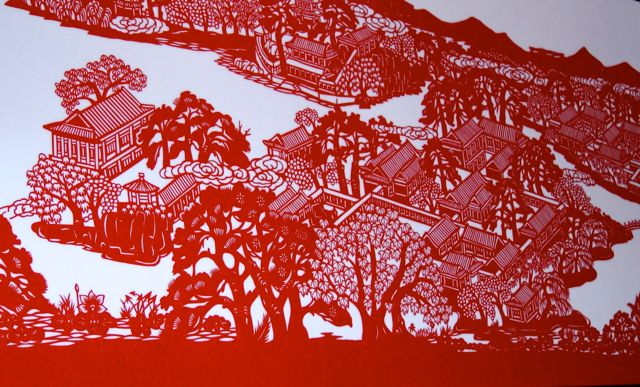
    [/et_pb_text][et_pb_image src=”https://journeyswithstephen.com/wp-content/uploads/2016/08/Junfeng-Paper-Cutting-Chengde-China.jpg” alt=”Junfeng Paper Cutting Chengde China” title_text=”Junfeng Paper Cutting Chengde China” align_tablet=”center” align_last_edited=”on|desktop” admin_label=”Junfeng Paper Cutting Chengde China” _builder_version=”4.16″ use_border_color=”off” border_color=”#ffffff” border_style=”solid” animation=”off” sticky=”off” always_center_on_mobile=”on” global_colors_info=”{}” align_phone=”center”][/et_pb_image][et_pb_text admin_label=”Text” _builder_version=”4.16″ background_size=”initial” background_position=”top_left” background_repeat=”repeat” use_border_color=”off” border_color=”#ffffff” border_style=”solid” global_colors_info=”{}”]One highlight of our city visit is the Junfeng Paper Cutting shop. We get a demonstration of the art of Chinese paper cutting, which dates back to the 6th century. This is the shop of Shi Junfeng, and her works for purchase here are some of the finest examples I have seen anywhere.
    [/et_pb_text][et_pb_video _builder_version=”4.21.2″ _module_preset=”default” src=”https://youtu.be/bIT0sWMV0EU” admin_label=”Performance at Jinshanling video” hover_enabled=”0″ sticky_enabled=”0″][/et_pb_video][et_pb_text admin_label=”Text” _builder_version=”4.16″ background_size=”initial” background_position=”top_left” background_repeat=”repeat” use_border_color=”off” border_color=”#ffffff” border_style=”solid” global_colors_info=”{}”]

    Gateway to Jinshanling Great Wall

    Just over an hour southwest from Chengde (and on the way to Beijing) lies the Jinshanling section of the Great Wall of China. It is one of my favorite sections – well preserved, part restored, part wild. It’s generally uncrowded, due to being more remote from Beijing than Badaling, Mutianyu, etc. And people of all ages can hike this section.

    You can learn more about this region in my post about U.S.-China Tourism. Now that the secret is out, does Chengde sound like a place you would want to visit? Feel free to comment at the bottom of this post.
    [/et_pb_text][et_pb_code admin_label=”Code for map” _builder_version=”4.21.2″ hover_enabled=”0″ saved_tabs=”all” global_colors_info=”{}” sticky_enabled=”0″][/et_pb_code][/et_pb_column][et_pb_column type=”1_4″ _builder_version=”4.16″ custom_padding=”|||” global_colors_info=”{}” custom_padding__hover=”|||”][et_pb_text admin_label=”Text” _builder_version=”4.16″ background_size=”initial” background_position=”top_left” background_repeat=”repeat” use_border_color=”off” border_color=”#ffffff” border_style=”solid” global_colors_info=”{}”]

    What’s upscale?

    Original large Chinese paper cuts are exquisite unique gifts for friends and family – I suggest lunar birth animals. They are also lightweight and easy to transport.

    What’s budget?

    Admission fees to these UNESCO attractions are reasonable, between US$10-20 and Jinshanling Great Wall tickets are even less.


    [/et_pb_text][et_pb_social_media_follow follow_button=”on” admin_label=”Social Media Follow” _builder_version=”4.16″ link_shape=”rounded_rectangle” saved_tabs=”all” global_colors_info=”{}”][et_pb_social_media_follow_network social_network=”instagram” url=”http://www.instagram.com/journeyswithstephen” _builder_version=”4.16″ background_color=”#517fa4″ bg_color=”#517fa4″ global_colors_info=”{}” follow_button=”on” url_new_window=”on”] Instagram [/et_pb_social_media_follow_network][et_pb_social_media_follow_network social_network=”twitter” url=”http://www.twitter.com/journeystephen” _builder_version=”4.16″ background_color=”#00aced” bg_color=”#00aced” global_colors_info=”{}” follow_button=”on” url_new_window=”on”] Twitter [/et_pb_social_media_follow_network][et_pb_social_media_follow_network social_network=”facebook” url=”http://www.facebook.com/journeyswithstephen” _builder_version=”4.16″ background_color=”#3b5998″ bg_color=”#3b5998″ global_colors_info=”{}” follow_button=”on” url_new_window=”on”] facebook [/et_pb_social_media_follow_network][/et_pb_social_media_follow][/et_pb_column][/et_pb_row][/et_pb_section]
  • How to see Kyoto in a weekend

    How to see Kyoto in a weekend

    [et_pb_section fb_built=”1″ admin_label=”section” _builder_version=”4.16″ global_colors_info=”{}”][et_pb_row admin_label=”row” _builder_version=”4.16″ background_size=”initial” background_position=”top_left” background_repeat=”repeat” global_colors_info=”{}” column_structure=”3_4,1_4″][et_pb_column type=”3_4″ _builder_version=”4.16″ custom_padding=”|||” global_colors_info=”{}” custom_padding__hover=”|||”][et_pb_text admin_label=”Text” _builder_version=”4.16″ background_size=”initial” background_position=”top_left” background_repeat=”repeat” use_border_color=”off” border_color=”#ffffff” border_style=”solid” global_colors_info=”{}”]I am dealing with the urban sprawl and hectic pace of Tokyo, and I long for a more manageable Japanese cultural experience. Kyoto is just a couple of hours away by bullet train. Is it worth trying to see Kyoto with just a weekend to spare? The answer is yes!

    I often visit a place the first time on a “highlights” schedule to determine if I would want to return and spend more time or not. One might argue that two days would not do Kyoto justice. I would argue that two days begins to give one the appreciation that this is a special region worth a deeper exploration, but still satisfying for a short visit. So here goes!
    [/et_pb_text][et_pb_image src=”https://journeyswithstephen.com/wp-content/uploads/2016/02/Shinkansen-train-Tokyo-to-Kyoto.jpg” alt=”Shinkansen train Tokyo to Kyoto” title_text=”Shinkansen train Tokyo to Kyoto” align_tablet=”center” align_last_edited=”on|desktop” admin_label=”Shinkansen train Tokyo to Kyoto” _builder_version=”4.16″ use_border_color=”off” border_color=”#ffffff” border_style=”solid” animation=”off” sticky=”off” always_center_on_mobile=”on” global_colors_info=”{}” align_phone=”center”][/et_pb_image][et_pb_text admin_label=”Text” _builder_version=”4.27.4″ background_size=”initial” background_position=”top_left” background_repeat=”repeat” hover_enabled=”0″ use_border_color=”off” border_color=”#ffffff” border_style=”solid” global_colors_info=”{}” sticky_enabled=”0″]

    I depart Tokyo’s Shinjuku station Friday morning on the Shinkansen bullet train for a direct trip to Kyoto. We reach speeds of 320 km/hr. By lunchtime I have checked into the Westin Miyako and am ready to explore some temples or shrines.

    First we need to understand the difference between a temple and a shrine. Westerners could think of it as the difference between a church and a synagogue. The Shinto religion, often associated with more earthly matters, is practiced at a shrine. Buddhism, the religion of more spiritual matters, is practiced at a temple. That’s a simplification, but it works for now.

    [/et_pb_text][et_pb_image src=”https://journeyswithstephen.com/wp-content/uploads/2016/02/Monks-at-Ginkaku-ji-temple.jpg” alt=”Monks at Ginkaku-ji temple” title_text=”Monks at Ginkaku-ji temple” align_tablet=”center” align_last_edited=”on|desktop” admin_label=”Monks at Ginkaku-ji temple” _builder_version=”4.16″ use_border_color=”off” border_color=”#ffffff” border_style=”solid” animation=”off” sticky=”off” always_center_on_mobile=”on” global_colors_info=”{}” align_phone=”center”][/et_pb_image][et_pb_text admin_label=”Text” _builder_version=”4.16″ background_size=”initial” background_position=”top_left” background_repeat=”repeat” use_border_color=”off” border_color=”#ffffff” border_style=”solid” global_colors_info=”{}”]So we must visit both a shrine and a temple. But there are thousands to choose from. This weekend we will see the three I would suggest on a short first-time trip.

    Ginkaku-ji Temple (The Silver Pavilion)

    From my hotel, this temple is at the end of a pleasant stroll along an old canal lined with cherry trees. The adjacent little alley is called “The Path of Philosophy.” It is also temple row, with inviting stops at Nanzen-ji Temple, Eikan-do Temple and several others. At the end of the path we reach our destination.
    [/et_pb_text][et_pb_image src=”https://journeyswithstephen.com/wp-content/uploads/2016/02/Ginkaku-ji-temple-cemetery-Kyoto.jpg” alt=”Ginkaku-ji temple cemetery Kyoto” title_text=”Ginkaku-ji temple cemetery Kyoto” align_tablet=”center” align_last_edited=”on|desktop” admin_label=”Ginkaku-ji temple cemetery Kyoto” _builder_version=”4.16″ use_border_color=”off” border_color=”#ffffff” border_style=”solid” animation=”off” sticky=”off” always_center_on_mobile=”on” global_colors_info=”{}” align_phone=”center”][/et_pb_image][et_pb_text admin_label=”Text” _builder_version=”4.16″ background_size=”initial” background_position=”top_left” background_repeat=”repeat” use_border_color=”off” border_color=”#ffffff” border_style=”solid” global_colors_info=”{}”]While it is called The Silver Pavilion, it is not coated in silver leaf. Instead, this 15th century temple is a perfect example of a complex of buildings and gardens and woods that inspires peace and tranquility. You could be hundreds of miles from the city, but you are not.

    In some ways Ginkaku-Ji (aka Higashiyama Jisho-Ji) will become my favorite temple in Kyoto. The crowds seem to be elsewhere, and one can reflect and appreciate all things natural and spiritual. I stroll the grounds, watch monks, and see a little fountain with water shooting out of a dragon’s mouth. A tiny cemetery is both reverent and picturesque. Allow a couple of hours for the whole experience in tranquility.
    [/et_pb_text][et_pb_image src=”https://journeyswithstephen.com/wp-content/uploads/2016/02/Dragon-fountain-Ginkaku-ji-temple.jpg” alt=”Dragon fountain Ginkaku-ji temple” title_text=”Dragon fountain Ginkaku-ji temple” align_tablet=”center” align_last_edited=”on|desktop” admin_label=”Dragon fountain Ginkaku-ji temple” _builder_version=”4.16″ use_border_color=”off” border_color=”#ffffff” border_style=”solid” animation=”off” sticky=”off” always_center_on_mobile=”on” global_colors_info=”{}” align_phone=”center”][/et_pb_image][et_pb_text admin_label=”Text” _builder_version=”4.27.4″ background_size=”initial” background_position=”top_left” background_repeat=”repeat” hover_enabled=”0″ use_border_color=”off” border_color=”#ffffff” border_style=”solid” global_colors_info=”{}” sticky_enabled=”0″]

    Friday evening I visit the famous Gion or Geisha district.

    Gion is the most famous district of Kyoto, with traditional homes and businesses tucked neatly along backstreets. The best way to see it is with a guide. WaRaiDo offers an English-speaking guide who conducts about a 3-hour walking tour on Friday evenings, perfect for our weekend getaway.

    [/et_pb_text][et_pb_image src=”https://journeyswithstephen.com/wp-content/uploads/2016/02/Stephen-and-kimono-girl-in-Kyoto.jpg” alt=”Stephen Henson and kimono girl in Kyoto” title_text=”Stephen Henson and kimono girl in Kyoto” align_tablet=”center” align_last_edited=”on|desktop” admin_label=”Stephen and kimono girl in Kyoto” _builder_version=”4.16″ use_border_color=”off” border_color=”#ffffff” border_style=”solid” animation=”off” sticky=”off” always_center_on_mobile=”on” global_colors_info=”{}” align_phone=”center”][/et_pb_image][et_pb_text admin_label=”Text” _builder_version=”4.16″ background_size=”initial” background_position=”top_left” background_repeat=”repeat” use_border_color=”off” border_color=”#ffffff” border_style=”solid” global_colors_info=”{}”]You will learn more than you thought possible about the world of Maiko (apprentices) and Geisha culture. It is a great way to be immersed into the history, life, and entertainment of Kyoto. As a tip, I suggest arriving to the tour early so you can get to know the guide and bombard her with a million questions before others arrive.

    We have a lot to accomplish on Saturday, our one full day in Kyoto – shopping, a shrine, dinner, a street fair – so let’s get going!

    I’m not a big shopper, especially when time is limited. But I do enjoy a local city market. Kyoto has several, but none better than the famous Nishiki Market. From fashion to food, this area, which actually encompasses several streets just off the main shopping drag downtown, is a treasure.
    [/et_pb_text][et_pb_image src=”https://journeyswithstephen.com/wp-content/uploads/2016/02/Kyoto-octopus-and-quail-egg.jpg” alt=”Kyoto octopus and quail egg” title_text=”Kyoto octopus and quail egg” align_tablet=”center” align_last_edited=”on|desktop” admin_label=”Kyoto octopus and quail egg” _builder_version=”4.16″ use_border_color=”off” border_color=”#ffffff” border_style=”solid” animation=”off” sticky=”off” always_center_on_mobile=”on” global_colors_info=”{}” align_phone=”center”][/et_pb_image][et_pb_text admin_label=”Text” _builder_version=”4.16″ background_size=”initial” background_position=”top_left” background_repeat=”repeat” use_border_color=”off” border_color=”#ffffff” border_style=”solid” global_colors_info=”{}”]Boutiques range from a store where you can buy Japanese kimono sandals with matching purse to a dedicated Hello Kitty store. I find a shop that sells local crafts and buy a little carved and hand-painted penguin for my daughter.

    There are plenty of food stands. I can’t bring myself to try quail egg cooked inside the head of an octopus, but a homemade green tea ice cream cone hits the spot on a hot day.
    [/et_pb_text][et_pb_image src=”https://journeyswithstephen.com/wp-content/uploads/2016/02/Kyoto-green-tea-ice-cream-cone.jpg” alt=”Kyoto green tea ice cream cone” title_text=”Kyoto green tea ice cream cone” align_tablet=”center” align_last_edited=”on|desktop” admin_label=”Kyoto green tea ice cream cone” _builder_version=”4.16″ use_border_color=”off” border_color=”#ffffff” border_style=”solid” animation=”off” sticky=”off” always_center_on_mobile=”on” global_colors_info=”{}” align_phone=”center”][/et_pb_image][et_pb_text admin_label=”Text” _builder_version=”4.16″ background_size=”initial” background_position=”top_left” background_repeat=”repeat” use_border_color=”off” border_color=”#ffffff” border_style=”solid” global_colors_info=”{}”]

    It’s then a short subway ride to Fushimi Inari-taisha Shrine.

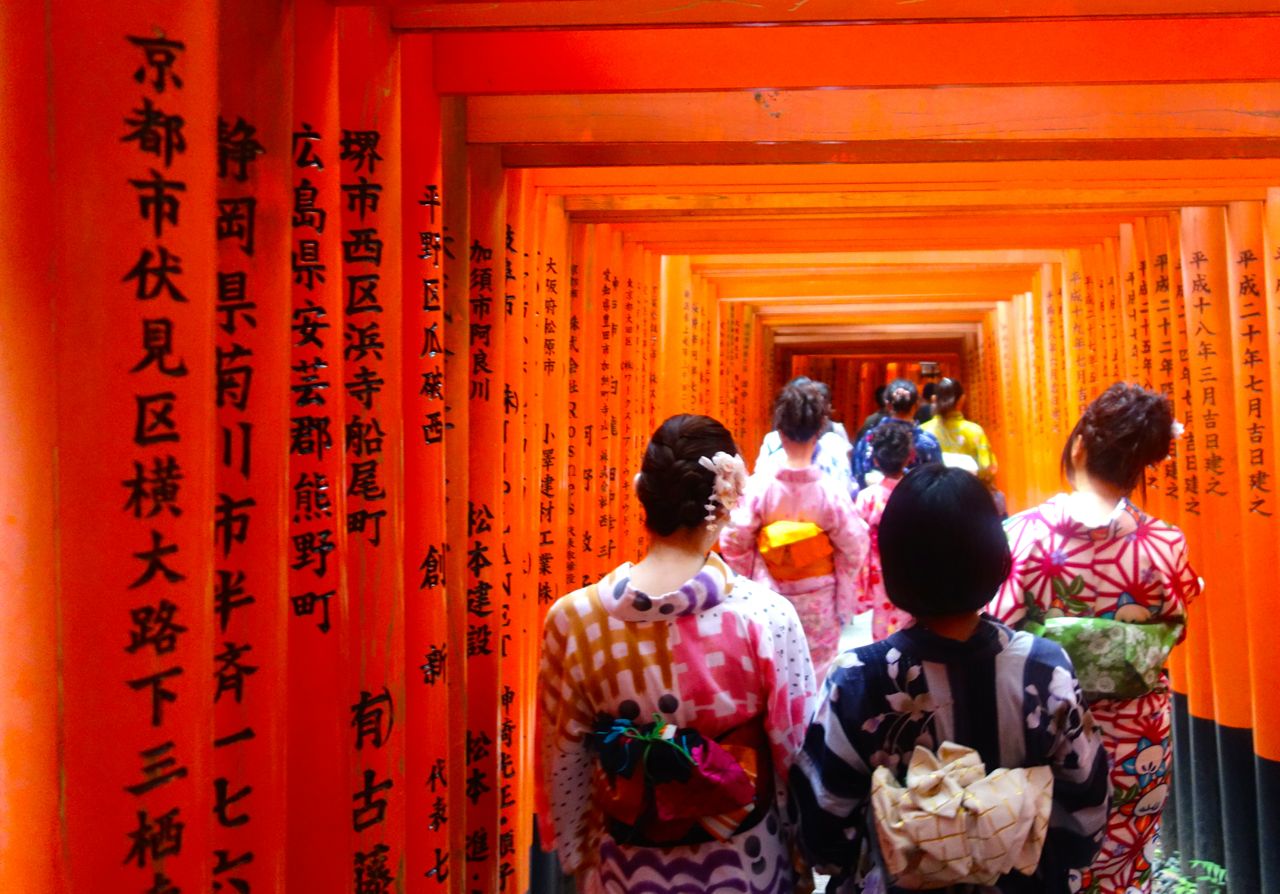
    This is number one on the greatest hits of Japanese shrines. The immense, hilly grounds are marked by thousands of bright orange torii gates that seemingly wind on forever. Eerie graveyards and miniature shrines highlight the breaks between them. There is plenty of history, too. The shrine was dedicated to the god of rice and sake back in the 8th century.
    [/et_pb_text][et_pb_image src=”https://journeyswithstephen.com/wp-content/uploads/2016/02/Fushimi-Inari-shrine-posts.jpg” alt=”Fushimi Inari shrine posts” title_text=”Fushimi Inari shrine posts” align_tablet=”center” align_last_edited=”on|desktop” admin_label=”Fushimi Inari shrine posts” _builder_version=”4.16″ use_border_color=”off” border_color=”#ffffff” border_style=”solid” animation=”off” sticky=”off” always_center_on_mobile=”on” global_colors_info=”{}” align_phone=”center”][/et_pb_image][et_pb_text admin_label=”Text” _builder_version=”4.16″ background_size=”initial” background_position=”top_left” background_repeat=”repeat” use_border_color=”off” border_color=”#ffffff” border_style=”solid” global_colors_info=”{}”]Photographers will have a field day here. Hikers will be delighted by the enormous hilly layout. People-watchers will see plenty of kimono-clad girls. Casual visitors can just take in a portion and leave the rest for another time – and there must be one!

    The shrine is just a few-minute walk from either the JR Inari station (JR Nara Line) or Fushimiinari station (Keihan Line). You must allow at least a couple of hours for walking the grounds, but a half-day is preferable.

    All this walking has made me hungry!

    Japanese food is great. I’m guessing this is not the first time you have heard that. The biggest challenge in Kyoto is trying to choose from a seemingly endless array of cool restaurants that line the Kamo River, which slices through the heart of the city. In the summer, open-air dining areas unique to Kyoto, called Yuka, are constructed. That even extends the myriad of options.
    [/et_pb_text][et_pb_image src=”https://journeyswithstephen.com/wp-content/uploads/2016/02/Kyoto-restaurant-sign.jpg” alt=”Kyoto restaurant sign” title_text=”Kyoto restaurant sign” align_tablet=”center” align_last_edited=”on|desktop” admin_label=”Kyoto restaurant sign” _builder_version=”4.16″ use_border_color=”off” border_color=”#ffffff” border_style=”solid” animation=”off” sticky=”off” always_center_on_mobile=”on” global_colors_info=”{}” align_phone=”center”][/et_pb_image][et_pb_text admin_label=”Text” _builder_version=”4.16″ background_size=”initial” background_position=”top_left” background_repeat=”repeat” use_border_color=”off” border_color=”#ffffff” border_style=”solid” global_colors_info=”{}”]The place I choose for dinner specializes in grilled meats. The menu includes duck, deer, boar, ostrich and horse. Inspired by their restaurant sign (see photo above), I’m obliged to order the chicken/pork/beef steak combination. The edamame is the best I have ever eaten and the fries are spiced with wasabi. I wash it all down with a few local craft brews. Gochidou sama desita.
    [/et_pb_text][et_pb_image src=”https://journeyswithstephen.com/wp-content/uploads/2016/02/Kyoto-restaurant-dinner.jpg” alt=”Kyoto restaurant dinner” title_text=”Kyoto restaurant dinner” align_tablet=”center” align_last_edited=”on|desktop” admin_label=”Kyoto restaurant dinner” _builder_version=”4.16″ use_border_color=”off” border_color=”#ffffff” border_style=”solid” animation=”off” sticky=”off” always_center_on_mobile=”on” global_colors_info=”{}” align_phone=”center”][/et_pb_image][et_pb_text admin_label=”Text” _builder_version=”4.16″ background_size=”initial” background_position=”top_left” background_repeat=”repeat” use_border_color=”off” border_color=”#ffffff” border_style=”solid” global_colors_info=”{}”]Strolling down Kiyamachi Street after dinner, I encounter a nighttime local street fair. A hundred people are participating in some kind of local dance, many dressed up in kimonos. There are little games (I try hard not to win a goldfish). And for sale, cans of beer floating in tubs of icy water (I try hard to win this game). Everyone is smiling and friendly to me, though I seem to be the only foreigner crashing the party.
    [/et_pb_text][et_pb_image src=”https://journeyswithstephen.com/wp-content/uploads/2016/02/Kyoto-street-fair-dance.jpg” alt=”Kyoto street fair dance” title_text=”Kyoto street fair dance” align_tablet=”center” align_last_edited=”on|desktop” admin_label=”Kyoto street fair dance” _builder_version=”4.16″ use_border_color=”off” border_color=”#ffffff” border_style=”solid” animation=”off” sticky=”off” always_center_on_mobile=”on” global_colors_info=”{}” align_phone=”center”][/et_pb_image][et_pb_text admin_label=”Text” _builder_version=”4.16″ background_size=”initial” background_position=”top_left” background_repeat=”repeat” use_border_color=”off” border_color=”#ffffff” border_style=”solid” global_colors_info=”{}”]It looks like the nightlife is just beginning in Kyoto, but it has been a long day. Plus, we have one more temple to visit early Sunday morning.

    Kinkaku-ji Temple (The Golden Pavilion)

    This splendid temple is literally the symbol for Kyoto. Originally built in the 14th century, the current gold leaf-coated structure was reconstructed in 1955.
    [/et_pb_text][et_pb_image src=”https://journeyswithstephen.com/wp-content/uploads/2016/02/Kinkaku-ji-Golden-Pavilion-reflection.jpg” alt=”Kinkaku-ji Golden Pavilion reflection” title_text=”Kinkaku-ji Golden Pavilion reflection” align_tablet=”center” align_last_edited=”on|desktop” admin_label=”Kinkaku-ji Golden Pavilion reflection” _builder_version=”4.16″ use_border_color=”off” border_color=”#ffffff” border_style=”solid” animation=”off” sticky=”off” always_center_on_mobile=”on” global_colors_info=”{}” align_phone=”center”][/et_pb_image][et_pb_text admin_label=”Text” _builder_version=”4.16″ background_size=”initial” background_position=”top_left” background_repeat=”repeat” use_border_color=”off” border_color=”#ffffff” border_style=”solid” global_colors_info=”{}”]The biggest drawback to such a magnificent temple is its popularity. I arrive right at its 9:00 am opening, and there are already busloads of tourists from China, Italy and elsewhere. Waiting would not have helped; it is even more crowded when I leave. Everyone jockeys for the best spot to capture the temple with its reflection in the pond that leads to it. Do not let the crowds deter you. You will have a great experience.

    Note, try to go on a sunny day. The temple and its reflection look best in the morning sun. The grounds are also quite beautiful.
    [/et_pb_text][et_pb_image src=”https://journeyswithstephen.com/wp-content/uploads/2016/02/Kinkaku-ji-Golden-Pavilion-closeup.jpg” alt=”Kinkaku-ji Golden Pavilion closeup” title_text=”Kinkaku-ji Golden Pavilion closeup” align_tablet=”center” align_last_edited=”on|desktop” admin_label=”Kinkaku-ji Golden Pavilion closeup” _builder_version=”4.16″ use_border_color=”off” border_color=”#ffffff” border_style=”solid” animation=”off” sticky=”off” always_center_on_mobile=”on” global_colors_info=”{}” align_phone=”center”][/et_pb_image][et_pb_text admin_label=”Text” _builder_version=”4.16″ background_size=”initial” background_position=”top_left” background_repeat=”repeat” use_border_color=”off” border_color=”#ffffff” border_style=”solid” global_colors_info=”{}”]The second drawback is that the Golden Pavilion is on the far west side of Kyoto. Public transportation is not that convenient. Upscale travelers should splurge for a taxi to and from the temple. They are plentiful and save precious time too.

    Speaking of time, I must now jump in the hotel courtesy van and be shuttled back to the main train station for my bullet train back to Tokyo. In just a little over 48 hours we have managed to escape the trappings of the metropolis and immerse in a bit of Japan that is both ancient and modern, religious and secular, upscale and budget.

    Mata atode, Kyoto!
    [/et_pb_text][et_pb_code admin_label=”Code for map” _builder_version=”4.16″ saved_tabs=”all” global_colors_info=”{}”][/et_pb_code][/et_pb_column][et_pb_column type=”1_4″ _builder_version=”4.16″ custom_padding=”|||” global_colors_info=”{}” custom_padding__hover=”|||”][et_pb_text admin_label=”Text” _builder_version=”4.16″ background_size=”initial” background_position=”top_left” background_repeat=”repeat” use_border_color=”off” border_color=”#ffffff” border_style=”solid” global_colors_info=”{}”]

    What’s upscale?

    Reserve “Green Car” seats on the Shinkansen bullet train between Tokyo and Kyoto. It is sort of the equivalent of business class on a plane, at a reasonable cost.

    The suite at The Westin Miyako overlooks a traditional Japanese garden and is adjacent to a mountain trail.

    It is more enjoyable to use a local guide as you tour Gion, rather than try to manage it yourself.


    What’s budget?

    Temples and shrines are either free or a small donation.

    A lot of competition seems to keep restaurant and lodging costs lower than Tokyo.

    The meticulous subways are convenient and inexpensive.

     
    [/et_pb_text][et_pb_social_media_follow follow_button=”on” admin_label=”Social Media Follow” _builder_version=”4.16″ link_shape=”rounded_rectangle” saved_tabs=”all” global_colors_info=”{}”][et_pb_social_media_follow_network social_network=”instagram” url=”http://www.instagram.com/journeyswithstephen” _builder_version=”4.16″ background_color=”#517fa4″ bg_color=”#517fa4″ global_colors_info=”{}” follow_button=”on” url_new_window=”on”] Instagram [/et_pb_social_media_follow_network][et_pb_social_media_follow_network social_network=”twitter” url=”http://www.twitter.com/journeystephen” _builder_version=”4.22.2″ background_color=”#000000″ bg_color=”#00aced” global_colors_info=”{}” follow_button=”on” url_new_window=”on”] Twitter [/et_pb_social_media_follow_network][et_pb_social_media_follow_network social_network=”facebook” url=”http://www.facebook.com/journeyswithstephen” _builder_version=”4.16″ background_color=”#3b5998″ bg_color=”#3b5998″ global_colors_info=”{}” follow_button=”on” url_new_window=”on”] facebook [/et_pb_social_media_follow_network][/et_pb_social_media_follow][/et_pb_column][/et_pb_row][/et_pb_section]