The Untold Story of kbb.com . . . The Strategic Gamble That Transformed a 1920s Book Publisher Into an Internet Giant.
It was 1995, the first year of the world wide web. Google was still 3 years away from being launched out of a garage. Mark Zuckerberg was in elementary school. Steve Jobs’ iPhone was 12 years away. It was a much different world when I approached Bob and Mike Kelley with the novel idea of Kelley Blue Book having its own website. From humble beginnings as a tiny book publisher to the nation’s number one automotive site, this is the untold story of kbb.com.
Part 1: A little history to set the stage
1918
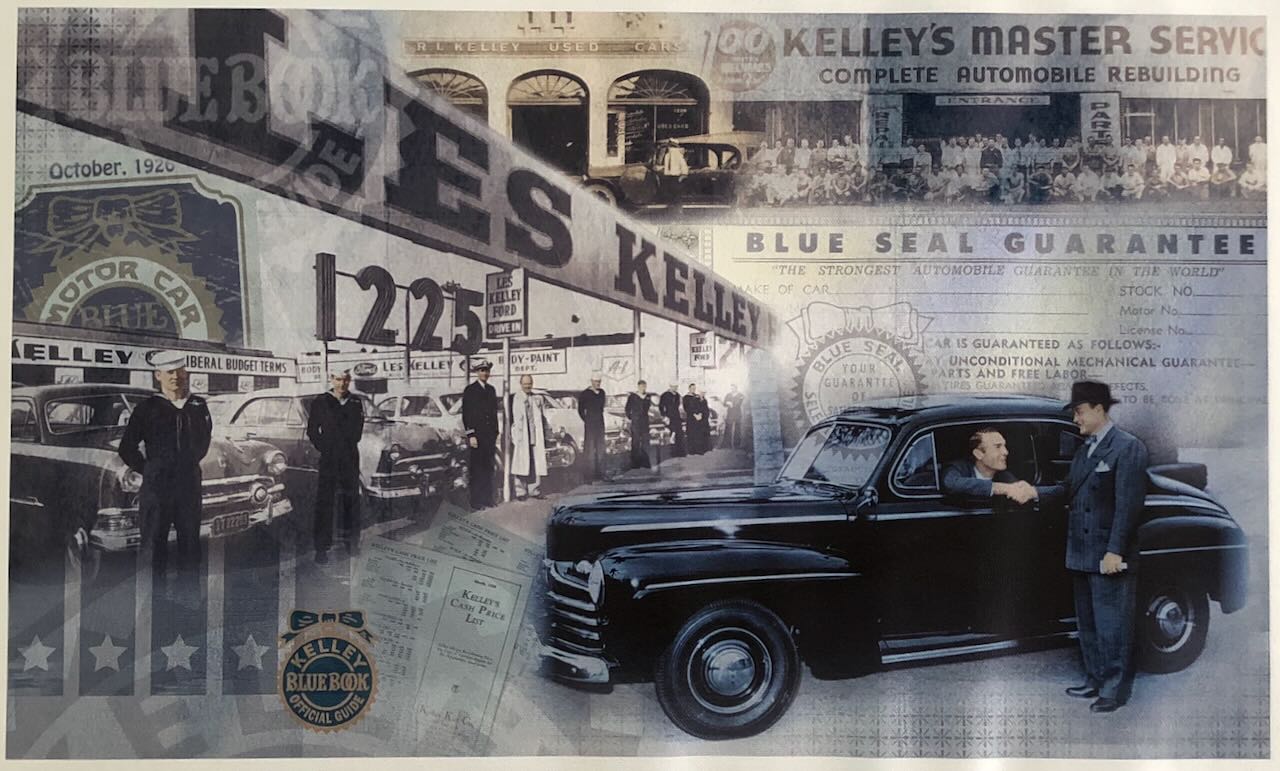
Les Kelley opened a small used car lot in Los Angeles in 1918. He and his brother, Buster, grew it into the Kelley Kar Company, which would become the largest used car and then largest Ford dealership in the world. There were countless innovations, such as Buster Kelley being the first to paint Model Ts a color other than black (see video below).
Other car sale novelties included a Blue Seal warranty, 5-year terms, a second mortgage, insurance, even the first dealer to advertise on television. Talk about a different world – Buster Kelley would sell a car to a family during the week, then on the weekend teach both husband and wife how to drive!
1926
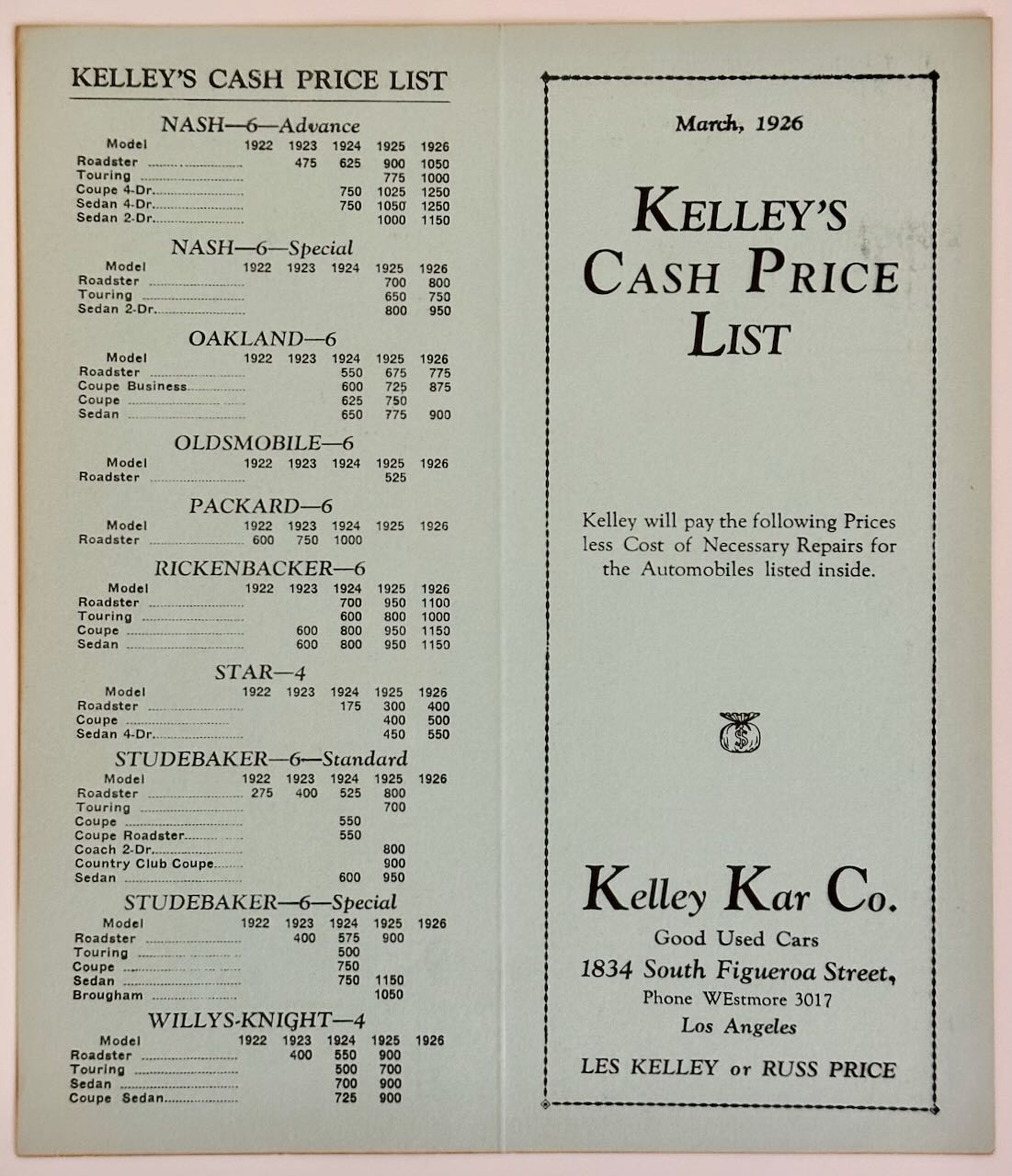
To acquire more cars Les Kelley would send a list to banks and dealers of the cars he needed and what he would pay for them. I have one of the original Kelley’s Cash Price Lists, from March, 1926 (see photo above). One time, when he didn’t send the list out, banks called to ask where it was. They had been using it as a way to put an accurate value on a car loan.
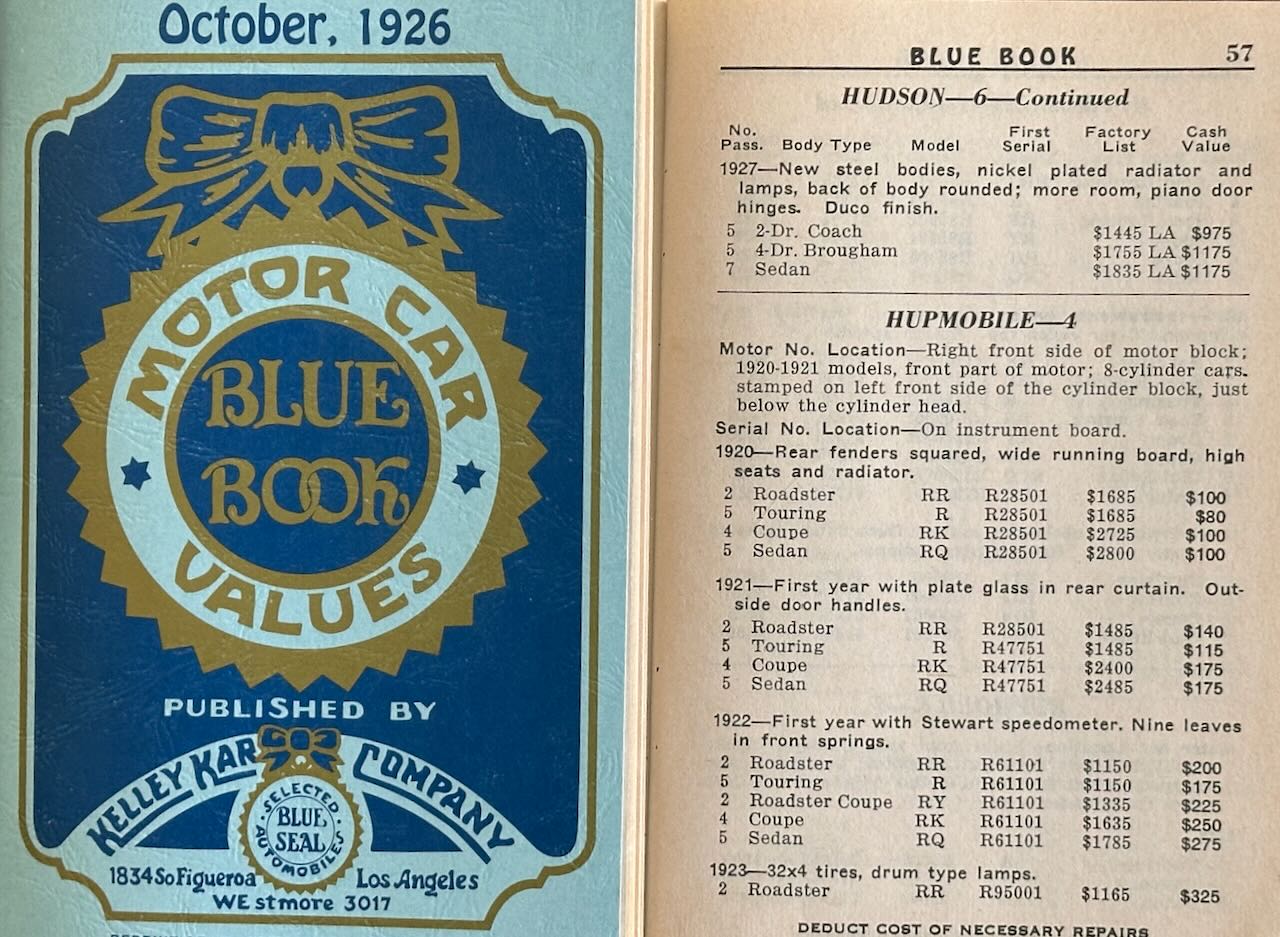
Les realized there was a potential business there, and in October, 1926, he published the Blue Book of Motor Car Values. He included values on more than 70 brands, including most we wouldn’t know today (Hupmobile, Essex, Packard, Studebaker, Pierce-Arrow). There was even a Stephens, whose 1924 Sedan DeLuxe was worth $325.
1962
During World War II, cars weren’t produced, and the government needed to a create a ceiling on prices of existing cars. They used the Blue Book, further promoting its need. The car business was doing well, but fearing another Great Depression, in 1962, Les sold the dealership.
1991
There were plenty of things that surprised me when I joined the company in 1991. After decades in business as a book publisher Kelley Blue Book was still a small company, with about 40 dedicated employees and sales of less than $10 million (though high gross margins). The company published 11 titles, including books with values on motorcycles, RVs, and more; but subscriptions totaled only about 200,000. What happened?
It turns out that Les Kelley had also sold the book business to the Cook family trust. In the deal, the Kelleys entered a long-term management agreement, including profit-sharing, but no longer owned the company. Like most trusts, their interest was in returning as much money as possible each year as distributions to the members. So, while the company performed well over the years, the profits were largely stripped away, leaving little capital for growth.
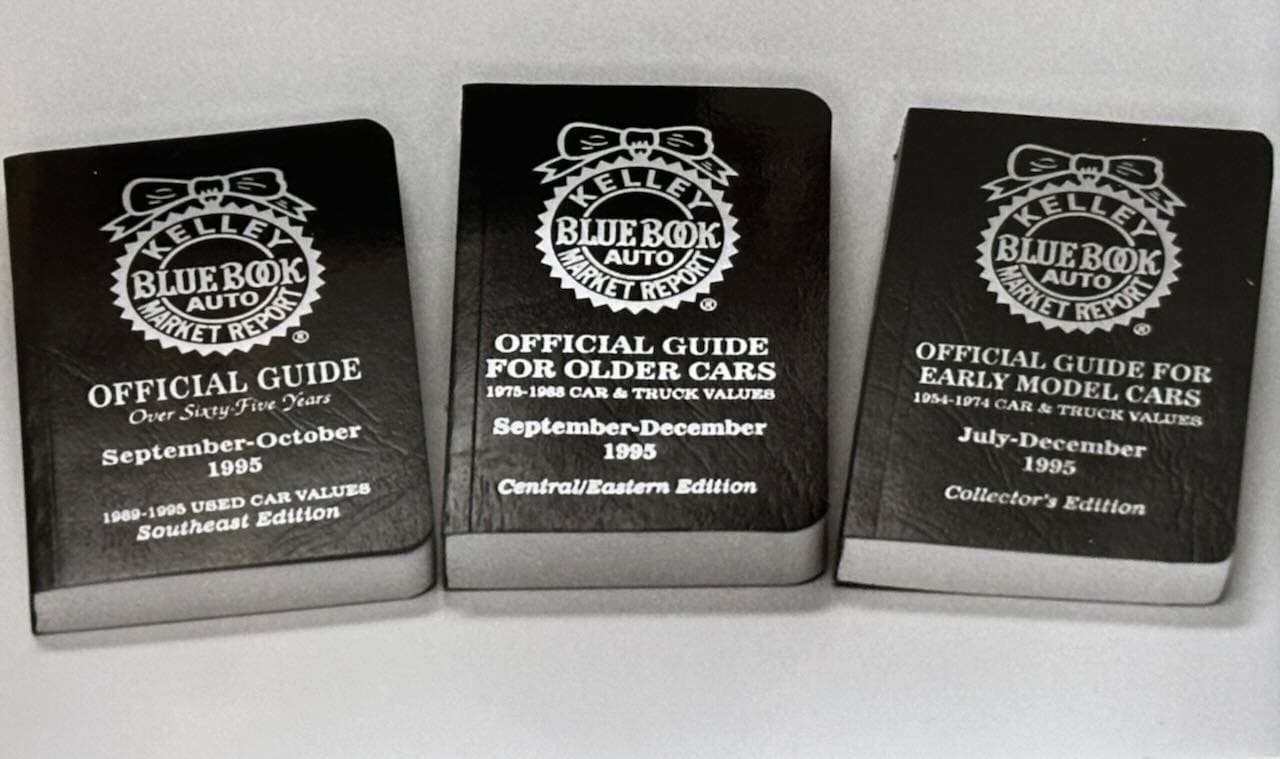
Competition for car values arose, and Kelley Blue Book, with no money for marketing, could only watch its competitors grow. Without a nationwide presence, other “books of color” gained market share – Black Book in the South, Red Book in the Midwest, and a yellow book from the National Auto Dealers Association (NADA). When I arrived in 1991, the Blue Book was far behind, with customers only in California and some western states. Consumers may have heard of “the blue book value of a car,” but the auto industry was using other sources!
The company had also attempted to expand into software, with a disk-based version of its new car pricing. The Kelley Blue Book Computerized New Car Price Manual was losing market share. Bob Kelley (Buster’s son) and Mike Kelley (Bob’s son) brought me on board to fix the issue, based on my 20 years of sales and marketing success in the computer industry at Sperry/Unisys. I shortened the name of the software to Powersystem, but raised the price, and sales took off.
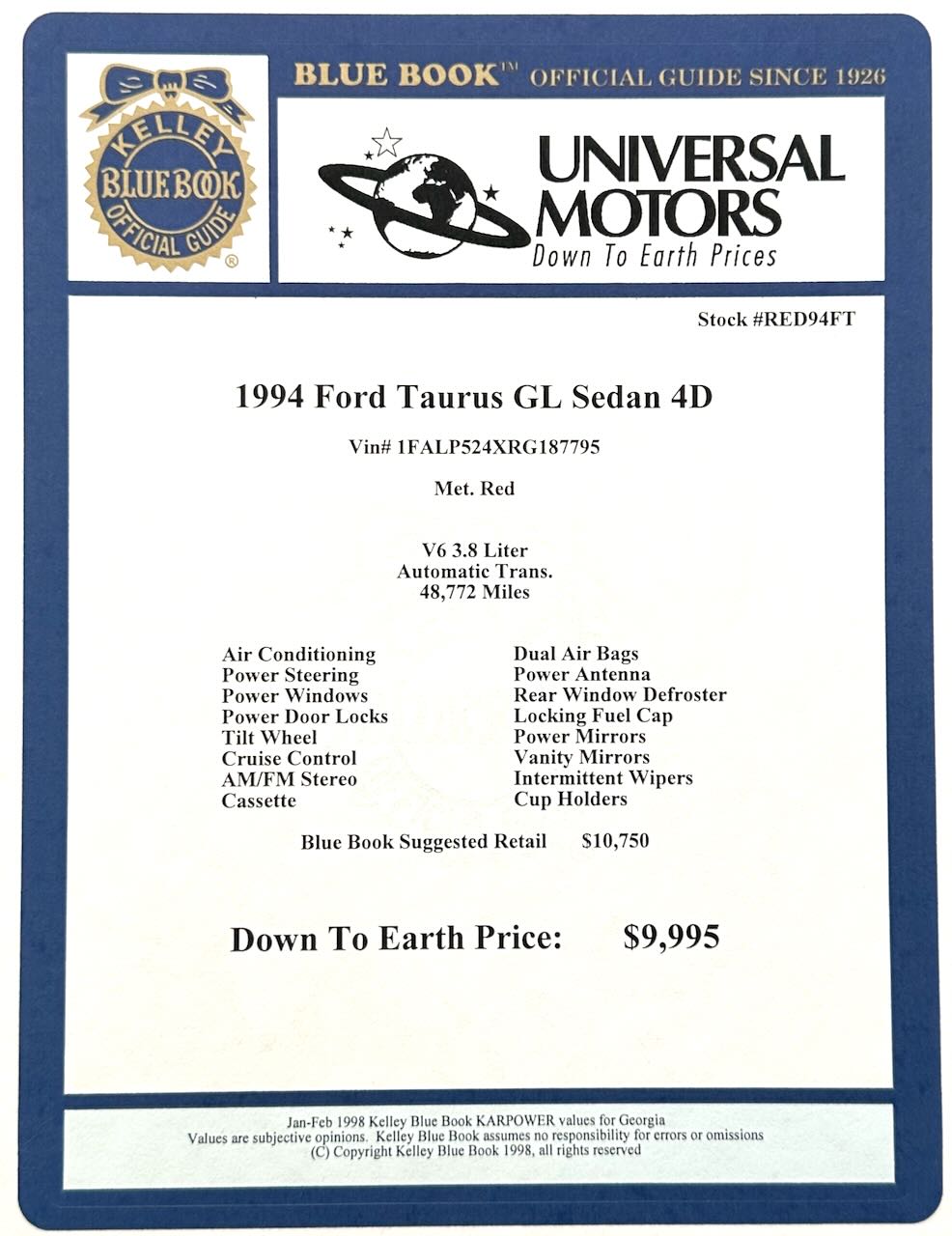
Next came a software version of the Blue Book, which I named KarPower, in homage to Kelley Kar Company. But something was missing. What if a car dealer could use KarPower to print a window sticker for their used cars, similar to the new car stickers? Now, what if their asking price could be shown next to the higher Blue Book Suggested Retail Price (like an MSRP for used cars). The idea caught on. Within a few years, we had more than 10,000 customers, making most of our money from millions of window stickers featuring the Blue Book Seal.
1993
In early 1993, Buster Kelley (yes, he was still there!) came to me with an idea. Why not put those same retail prices into a book and sell it to consumers? A few guides (Edmunds, Pace) were already available in bookstores. This was a chance to put the Blue Book brand to a test. Would the public buy our book because they trusted the name? Would it sell all over the country? By the end of the year, according to U.S.A. Today, the Blue Book Consumer Edition was the nation’s number one selling automotive-related book. I remember even outselling Oprah and Stephen King! There was nationwide trust in the Blue Book brand. It seems Les Kelley, a minister’s son, had created what the media now called the “automotive bible.” It was important to remember all this when I launched kbb.com some two years later.
Part 2: The World Wide Web is calling
1995
The Internet had been around for years, but commercial use didn’t really begin until 1995, with the introduction of websites and the .com domain. A directory service called yahoo.com launched, as did aol.com, and others. There were also proprietary systems, available to networks of users. Charlie Vogelheim, Kelley Blue Book’s long-time editor, worked hard to secure Blue Book values on the private Bloomberg Financial Network.
And in neighboring Irvine, California, a car dealer, Pete Ellis, created a website called Autobytel (standing for automobiles-by-telecommunication). He began marketing new cars online. Pete and Bob Kelley were good friends. One day, Pete invited Bob and me to Autobytel and pitched an idea. He knew I was exploring a website for Kelley Blue Book. “No need for that headache,” said Pete, always the salesman. “Just give me the Blue Book data, and I will display the information on Autobytel.” Fortunately, we passed on that offer, and Mike Kelley would lead the small tech team that began to build our own site.
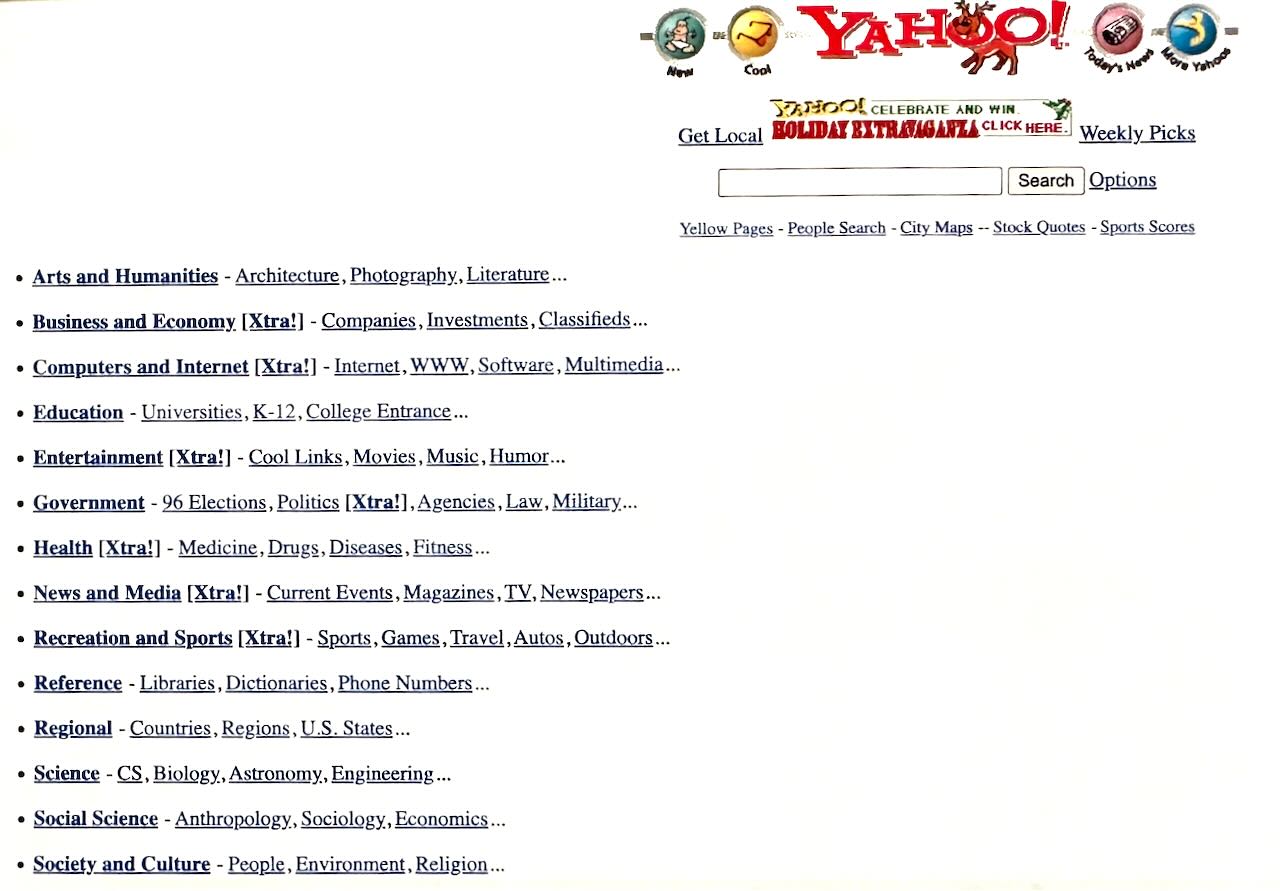
What should our domain name be? In mid-1995, there were no search engines. Yahoo was a directory site, with autos to be found under “Recreation and Sports.” You had to type in the specific web address to reach a site. And if you misspelled an address, you would simply be presented with a dead end “404 Not Found” page. So, we could choose kelleybluebook.com, but we already knew that most people misspell Kelley as Kelly. And there were no redirects in 1995. Dead end.
I decided that, since many consumers know Blue Book and not Kelley anyway, we should just go with bluebook.com. One slight problem. It was already owned by a small company in Arizona that published values on guns, guitars, and other stuff. No problem. We reached out to them and got them to agree to sell us the domain for a reasonable price.
Unfortunately, when Mike Kelley informed Alan Johnson, the head trustee, that we were going to buy a domain name, he said no. He didn’t believe there was a future to the Internet. Bluebook.com would not be ours until many years later.
Out of options, I asked Mike if he was familiar with International Business Machines. “Of course. You mean IBM.” Yes, and Minnesota Mining and Manufacturing became simply 3M. So, I suggested we call ourselves kbb.com. It’s short and easy to spell. The domain was available in those early days. The rest, as they say, is history. Today, thanks to Alan Johnson’s lack of foresight, the whole world knows us as kbb.com. And I became known as the founder of kbb.com.
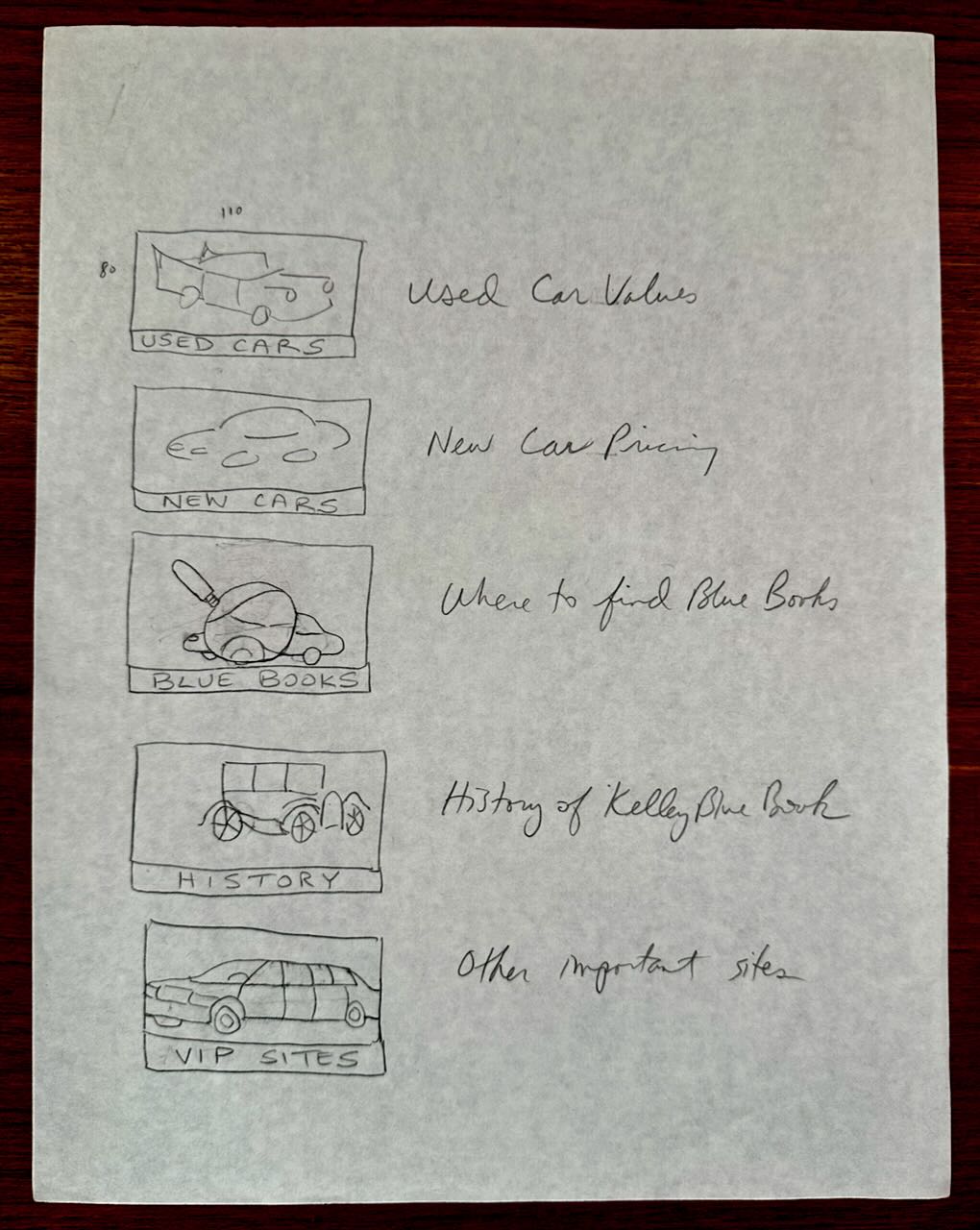
We started kbb.com in 1995 with some basic functions. In fact, I designed the home page (my first pencil sketch above), since we had no designers. We launched on a PC, which was housed off-site. It went down frequently, and I had to keep calling the little company (Grapevine) to ask them to reboot the server. Very soon we brought it in-house, and kbb.com was running on a PC under our programmer’s desk. No worries. While Apple, Amazon, and Google were launched out of garages, we were actually in an office!
Part 3: The strategic gamble: Free to consumers!
When I approached the Kelleys with the idea of a website that would deliver our information to consumers, the first question was “how are we going to make any money?” I thought I had an answer. We will start with new car pricing and charge $3.95 for delivering a detailed pricing report. Ok. We spent a few extra weeks developing the ability to accept a credit card payment. There was some healthy skepticism, but I remember Bob Kelley saying, “Well, let’s give it a try.”
The system worked. What I didn’t count on was the consumer reaction. In 1995, nearly all the websites were providing information for free. There were no payments. CNN.com was free and a beta site from the New York Times was free. We got a fair amount of “hate mail” from users saying, “The Internet is about free information for the people!” So much for capitalism. They did have a point, though. While our pricing report for a new Ford F-150, including all the configurations and options, might be a worthy several pages long, a simple Honda Civic only needed a few lines of pricing. So, people complained about spending $3.95 for “so little information” on a Honda.
I began to worry about the negative effect on our brand. We weren’t used to people complaining about us. After several weeks, we took the strategic gamble to remove the charge and provide the pricing reports for free. Of course, that led to the next question. How are we going to make money giving away our product line? And I didn’t know the answer yet! But first, in the untold story of kbb.com, we had a bigger problem.
Despite having those three industry book competitors, Kelley Blue Book was the only company that decided to launch a website for consumers. The biggest issue was that our offering new car pricing meant we would not only show the MSRP (list price) on a vehicle, but also something called “dealer invoice” – roughly what the car cost the dealer. For the first time, consumers would be able to see about how much profit a dealer was making on the vehicle and negotiate accordingly.
Not surprisingly, our competitors decided this was unfair to the auto industry. Black Book said that car buyers should never see dealer invoice. NADA, an organization made up of car dealers, obviously agreed. Dealers were highly upset. The California New Car Dealers Association, representing most of our customer base, threatened to stop using Kelley Blue Book altogether. They summoned Bob and Mike Kelley to Sacramento to deliver that ultimatum.
We had one ace up our sleeve. The consumer book publisher, Edmunds, had also launched its website. It was showing dealer invoice as well. The Kelleys, along with an important dealer, Bob Lewis, showed the Association some of Edmunds’ numbers that were simply wrong. It further hurt dealers. We argued that the “toothpaste was out of the tube.” Dealer invoice was out there, but dealers needed the trusted Kelley Blue Book to present it accurately. They voted in our favor. Crisis averted for now.
Part 4: Can a little book publisher play in this big sandbox?
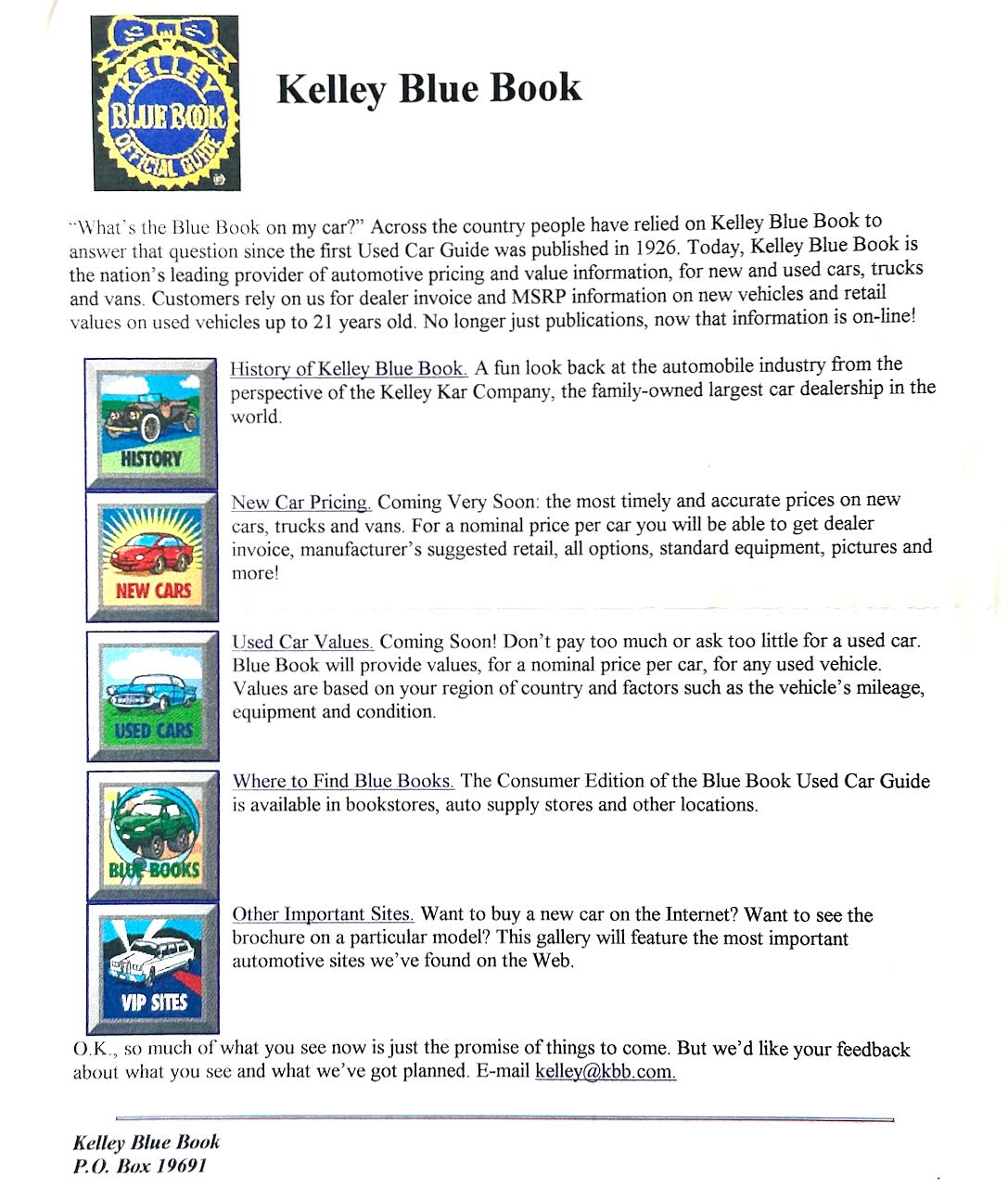
By the end of 1995, kbb.com featured New Car Pricing, a History section (to support the brand), and a section called Other Important Sites, with its “VIP Sites” graphic. Within it you could find links to Autobytel. To my knowledge, it made us the first company to implement lead generation on the web! Pete Ellis paid us $5.00 for every user who simply clicked over to the 350 car dealers on his site. Things were casual in the early Internet days. I remember our accountant asking me to explain why Autobytel was sending us “a lot of money” without anything in writing. So, I wrote a short note to Pete outlining our deal, which he signed and faxed back to us (we still didn’t have email).
Not everybody listed in Other Important Sites was really important. It became a place to stick industry “partners” who were maybe less important than they thought. I got the idea from the movie, Animal House. You may remember that all frat house pledges were important, but some, like Flounder and Pinto, were ushered to the basement. That’s where we would send Stoneage and some others.
1996
New car pricing was nice, but let’s face it, a car shopper really wanted to know, “What’s the Blue Book value of my car?” Trade-in value has always been a critical part of any car-buying negotiation. For decades a car dealer would subtly pull a little book out of his desk drawer (usually the yellow NADA book) and tell the owner officially what his car was worth. In 1996, we were now taking the next gamble by empowering the consumer and forever level the playing field.
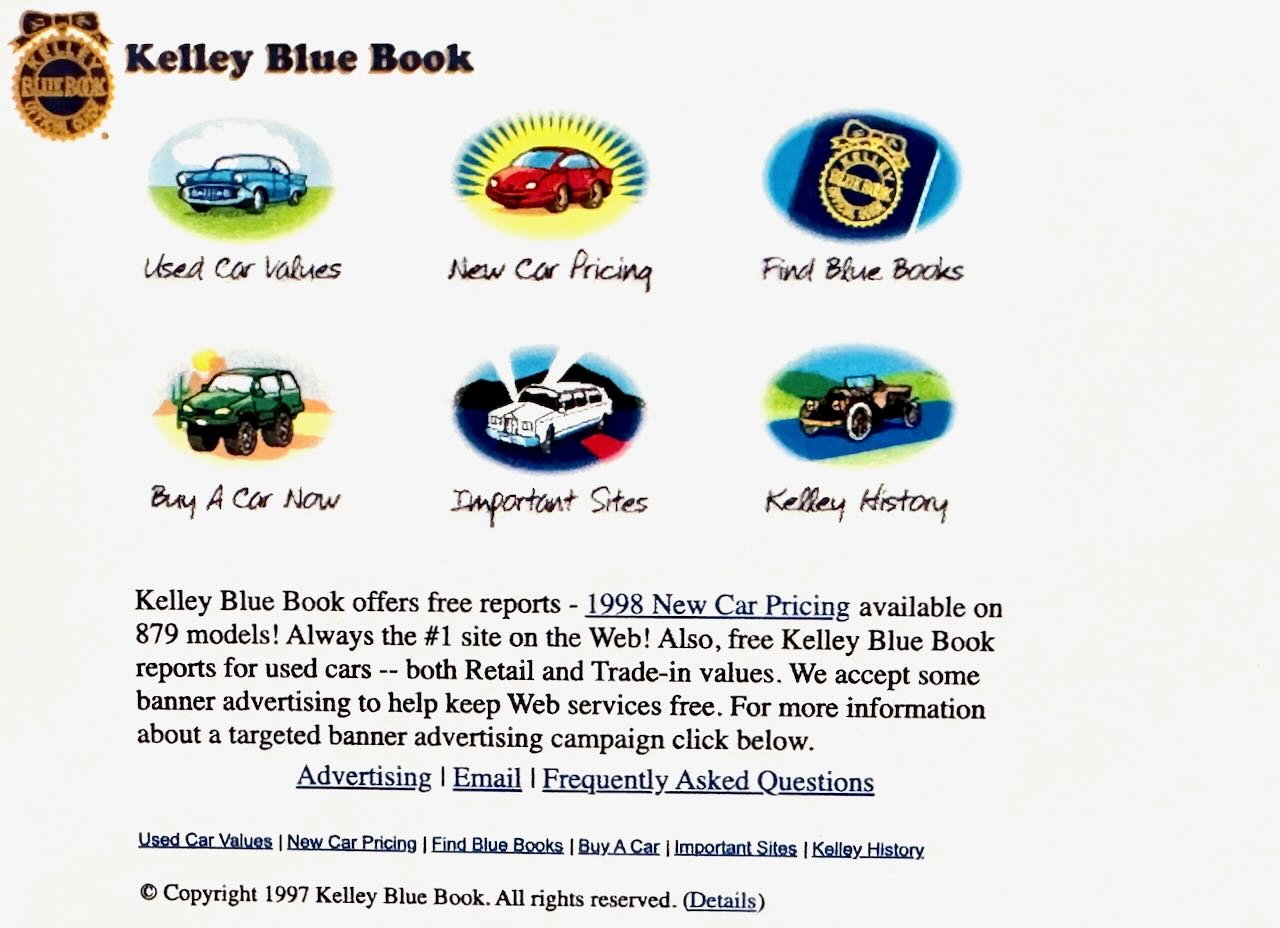
We also enabled car buyers to see the Blue Book Suggested Retail value on a used vehicle they might buy (the same as displayed on our window stickers). So, consumers now had the pricing information they needed for both new and used cars. But the overshadowing question remained – even if we scale this website, how do we make enough money? Bob Kelley was quoted in a New York Times article as saying, “This isn’t how we’re making our money. We’re making an investment in the future.” I hoped the future would pay off.
1997
Kevin O’Conner developed a concept for an online ad network, DoubleClick – not in his garage, but in his basement. In late 1996, using technology called DART (Dynamic Advertising Reporting and Targeting), DoubleClick signed up a small network of sites to deliver banner ads across the Internet. DoubleClick would sell the spots to traditional advertisers. They were the first to scale Internet advertising.
Hungry for a revenue source, I liked the idea. A consumer viewing Ford vehicles on kbb.com might want to click on an ad taking them to the manufacturer’s site. It took some convincing, but DoubleClick finally agreed to have us join their network in 1997. For kbb.com, it was a cost-effective way to develop relevant advertising revenue. DoubleClick handled everything from sales to delivery to reporting. For that, they kept 40% of the money. It was an early win-win.
1998
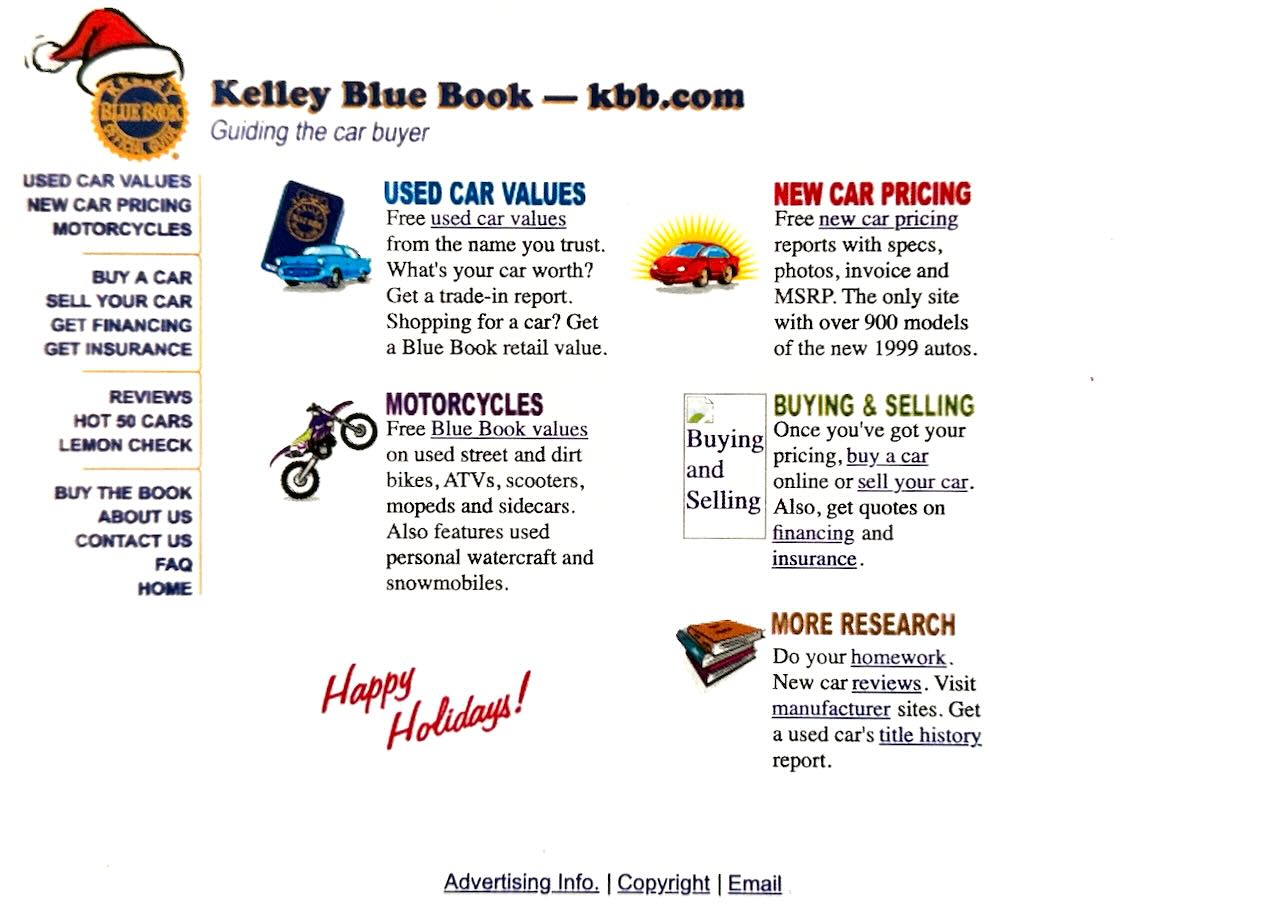
While still giving away our product line for free, I was constantly on the lookout for revenue sources. Those “Other Important Sites” morphed into a home page section called Buying and Selling. Lead generation was alive and well, and it enabled me to start working with some industry partners who would pay for the quality traffic we sent them. Steve Moretti and Brian Reed at PeopleFirst (which became Capital One) and E-Loan were early adopters who paid for our valuable car loan leads. Progressive and NetQuote did the same for car insurance. In addition to Autobytel, Frank and Payam Zamani, at Autoweb, were pioneers with online new car buying, as well as Bob Brisco at CarsDirect. On the used car side, I put deals together with some new companies called Cars.com and Autotrader.
1998 was an exciting time to be in business. The Internet seemed to have the potential to transform our lives. What if people started buying their books on Amazon instead of going into a Barnes & Noble or Borders? In the automotive business it takes years to conceive, develop and manufacture a new model, and only then do we learn if consumers really want to buy it. On the Internet we could come up with an idea, quickly put it on kbb.com and usually know within days if it made sense or not. The partners mentioned above yielded excellent results. It was a nice value-add for our customers, and our partners received quality leads. Some others we tested simply didn’t work. For example, TireRack.com, a good company, got no traction. Nobody on kbb.com seemed to be interested in buying tires online. That’s ok. It didn’t cost anything to try.
30 years from now you will tell a young person all about a time before AI, and they will give you a quizzical look. That was the Internet story in 1998. While some people believed it was the next big thing that would change our lives, many others thought it was vastly overrated hype. Sound familiar? Those of us who had founded websites certainly hoped it was the former. Kelley Blue Book’s traditional competitors stayed on the sidelines, hoping it would all go away. New ones, like Edmunds.com, were growing stronger by the day.
Against that backdrop, a couple hundred senior-level executives were invited to attend a high-level industry retreat in Beaver Creek, Colorado. It was called Camp Interactive. I was among the invited attendees. Most of the major brands were there, including media giants Procter & Gamble and General Motors. Between four days of white-water rafting and networking parties, we listened to media speeches about the potential future of web advertising and e-commerce.
With one exception, it was very inspiring, and I left with renewed vigor. The one exception was a very brief meeting with Wenda Millard, DoubleClick’s EVP, already a media legend. I introduced myself and wanted to talk about kbb.com’s value to automotive advertisers as part of the network. I will never forget her response: “I don’t have time to talk to you at this event. I have bigger fish to fry. I am going after ReadersDigest.com!” Wow. Readers Digest was an old company in serious decline and nowhere near a top-50 website. I don’t mean to cast aspersions on Wenda, who continued her stellar career; but it showed me that none of us really knew what the future would hold. We were building something without a blueprint. Flying without a safety net. Some of it would come crashing down as the “bubble burst.” Some of it would transform industries forever. Follow-up story: At least the talented Beth-Ann Eason, DoubleClick’s head of media, agreed to talk to me at the Camp.
Kbb.com strategy
By now, I had developed a pretty clear strategy of our role.
Give away the product line. If we could keep this free to consumers and make revenue via multiple business models, we would transform Kelley Blue Book and win in the end. And I was counting on the brand to drive the product.
Educate the consumer. Many car dealers told us what we already knew – owners over-value their cars. A buyer would come in and want $10,000 for their trade-in. The dealer would take them to kbb.com and say, “See, KBB says your car in good condition is worth $8,000.” With our trusted pricing online, we were actually helping, not hurting dealers! But meanwhile, we were also neutral – our “Switzerland” strategy.
Make the brand ubiquitous. I once got a copy of Peter Sealey’s strategy – he was Coca Cola’s head of global marketing at the time. His mission was to make sure Coke products had top-of-mind awareness. I decided that, wherever somebody was on the web, if they wondered about what their car was worth, there would be the Blue Book Seal right there to click on.
Extend the brand, but be champion of the transaction. We were already more than a trusted pricing tool, but I was careful not to dilute the brand. Our lane was to facilitate the car-buying transaction, not dive into ownership and other automotive businesses.
Part 5: The gamble begins to pay off
We never had the money to pay for industry analytics, but some friends at DoubleClick would sneak me the data from Media Metrix (now Comscore). Kbb.com had become the number one automotive site in the nation! Imagine, our little company, that still had only 54 employees, with more traffic than any auto company or any portal’s auto channel.
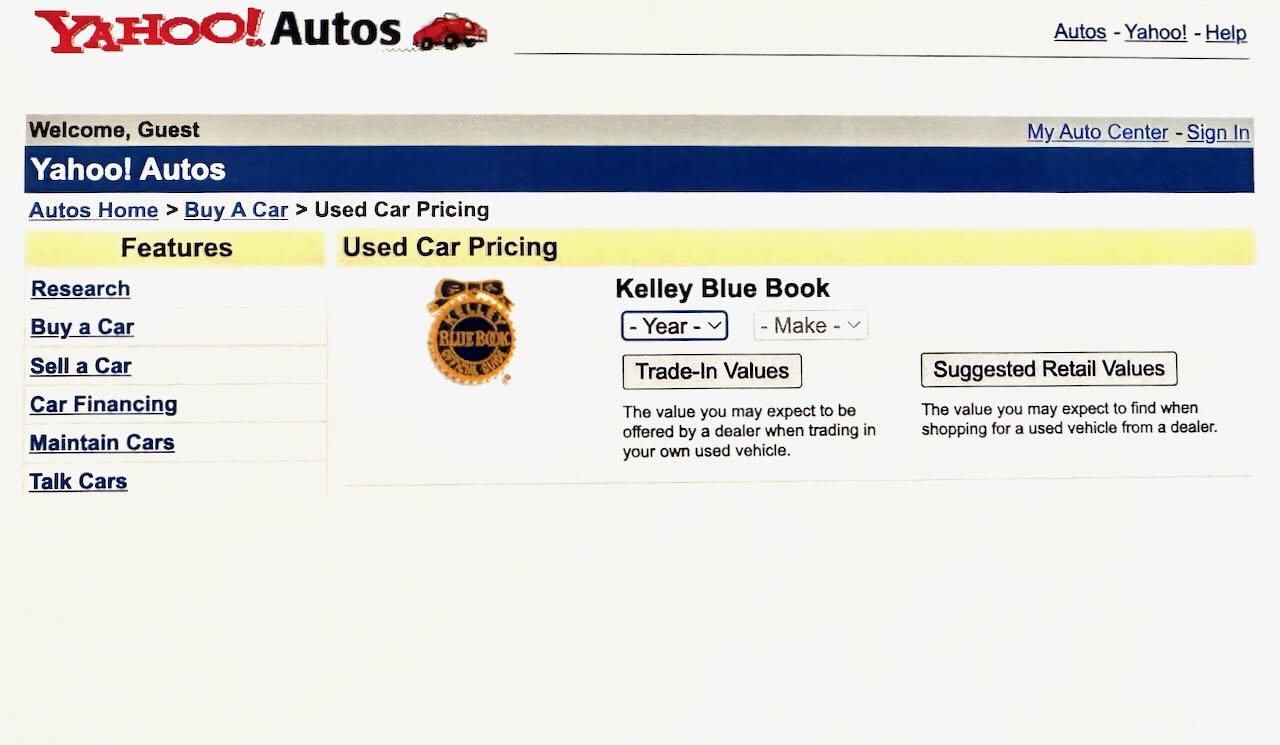
That ubiquitous brand strategy was working. More than 7,000 sites linked to kbb.com. We developed a product called “Control Mode,” in which a major partner, like Ann Crady Weiss at Yahoo Autos, could offer a customized KBB experience. The process of car pricing could start on their site, giving them important page views (with advertising revenue) before the user finished the visit on kbb.com. We now had 150 custom versions of kbb.com, charging these companies for the syndication of our information, while still retaining the user at the end.
Microsoft CarPoint was another major web portal I was talking to at the time. Having some industry people on staff, they were familiar with the “books of color.” They told me their plan was to feature Kelley Blue Book if the CarPoint user was coming from the West, but then feature NADA or Black Book values for the rest of the country. I flew to Redmond for one shot at changing their mind. I told Microsoft, “I’m sure you will be surveying consumers across the country to hear what values they want to receive. Do they want to know what their car is worth from Blue Book or from the Auto Dealers Association?” I don’t know if they ever surveyed consumers, but a week later they called to say it would be easier to implement one source for vehicle pricing and that would be Blue Book. CarPoint would become our only full license agreement, with Microsoft hosting all pages, but paying us a substantial fee.
1999
Remember that trust that owned Kelley Blue Book? By 1999, many start-ups were going IPO and were the darlings of Wall Street. All this success with kbb.com gave the trust the idea – why not sell Kelley Blue Book while it was the number one website? Blue Mountain Arts had just sold its nascent online greeting card business to Excite for the staggering sum of $350 million cash and $430 million stock! Alan Johnson had a number in mind for KBB, around $300 million for our tiny operation. But rather than spend the money to work with an M&A specialist, he decided he could sell the company himself. Paul Johnson (no relation) was brought in to manage the process internally.
Perhaps more shocking to employees was the news that the long-term management contract with the Kelleys would not be renewed. Bob Kelley was let go. Mike was being transitioned out. For the first time since 1918 there would not be a Kelley running their namesake company.
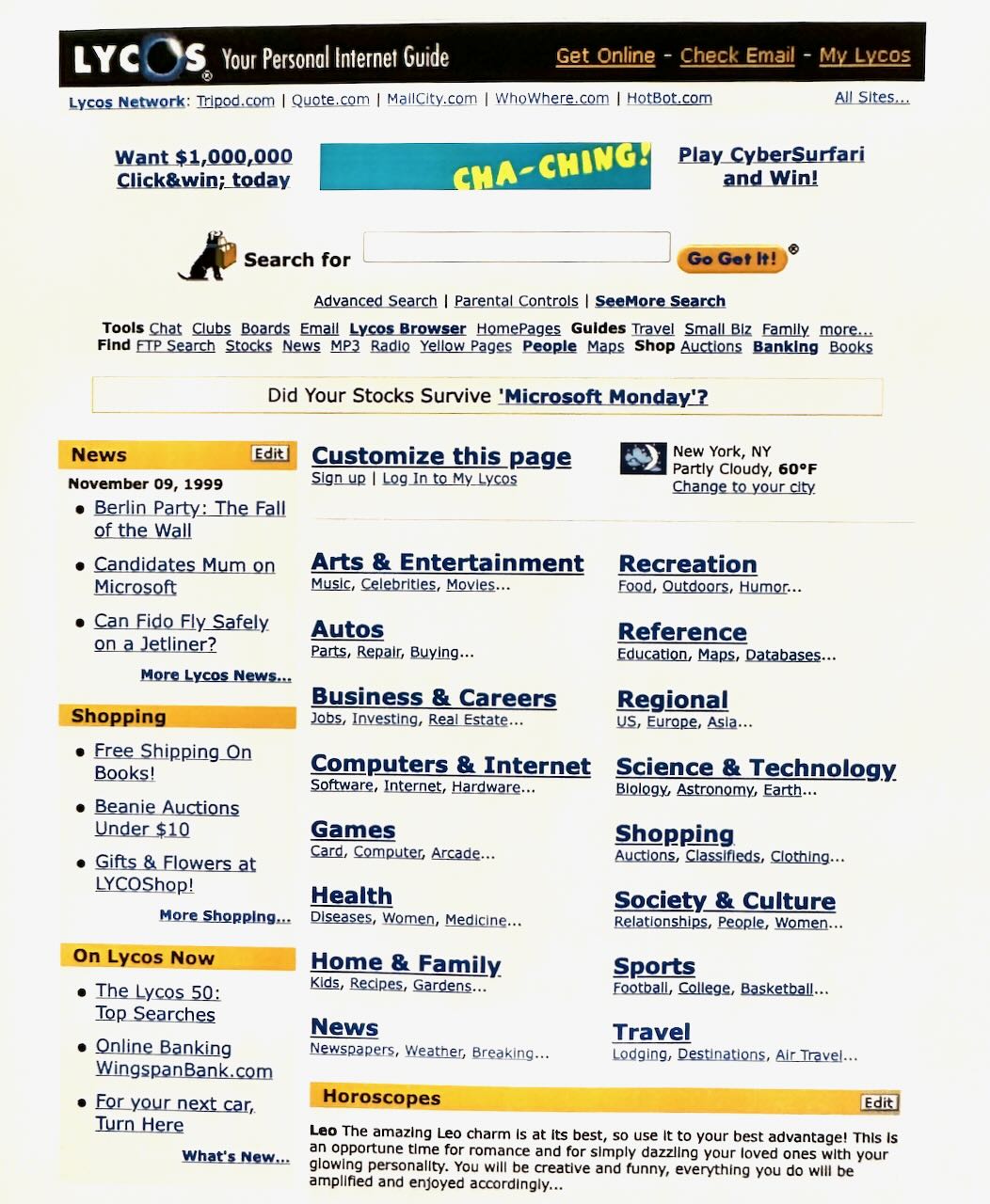
Anyone who has ever been an executive with a company that is for sale knows it can be a distraction to the business. Running the company’s sales, marketing, and product, I had a dozen people to manage, plus DoubleClick. Paul, Charlie, and I would disappear offsite for secret presentations to would-be buyers. There were serious offers. In Redmond, Microsoft revealed we were part of their “conquer the world” strategy. Their interest waned though, as they learned that vehicle valuation wasn’t all technology – there was art to go with the science. I remember being shown a Lycos org chart with me running the autos channel; they were ready to announce the purchase soon. A letter of intent was signed. Balloons were ordered. Then, following a minor disagreement on the price, Alan Johnson backed out of the deal.
And with that, just as suddenly as the company had gone up for sale, Kelley Blue Book was taken off the market. As a management team we were relieved. We had presented the story of our present and future success so many times that we actually started believing it! And feeling we could achieve those goals by ourselves.
Nearly everybody who worked for Kelley Blue Book reminisces that it was unlike any other company. The long-time Blue Book culture was based on loyalty, integrity, and a work/life balance. No one owned any shares (remember the profit-eating trust?). So, we had to attract people who cared about their unique role in the automotive landscape.
Warren Buffett famously said, when hiring, look for 3 qualities: integrity, intelligence, and energy. “And if they don’t have the first, the other two will kill you.” I told our people to always “do the right thing” – not necessarily what will make the most money, but what will support the brand.
It was a time when dotcoms were burning people out, working them 70+ hours a week. Kelley Blue Book developed a culture that said, “work hard, do your job, and go home to your family at 5 pm.” That created happy employees and a successful company.
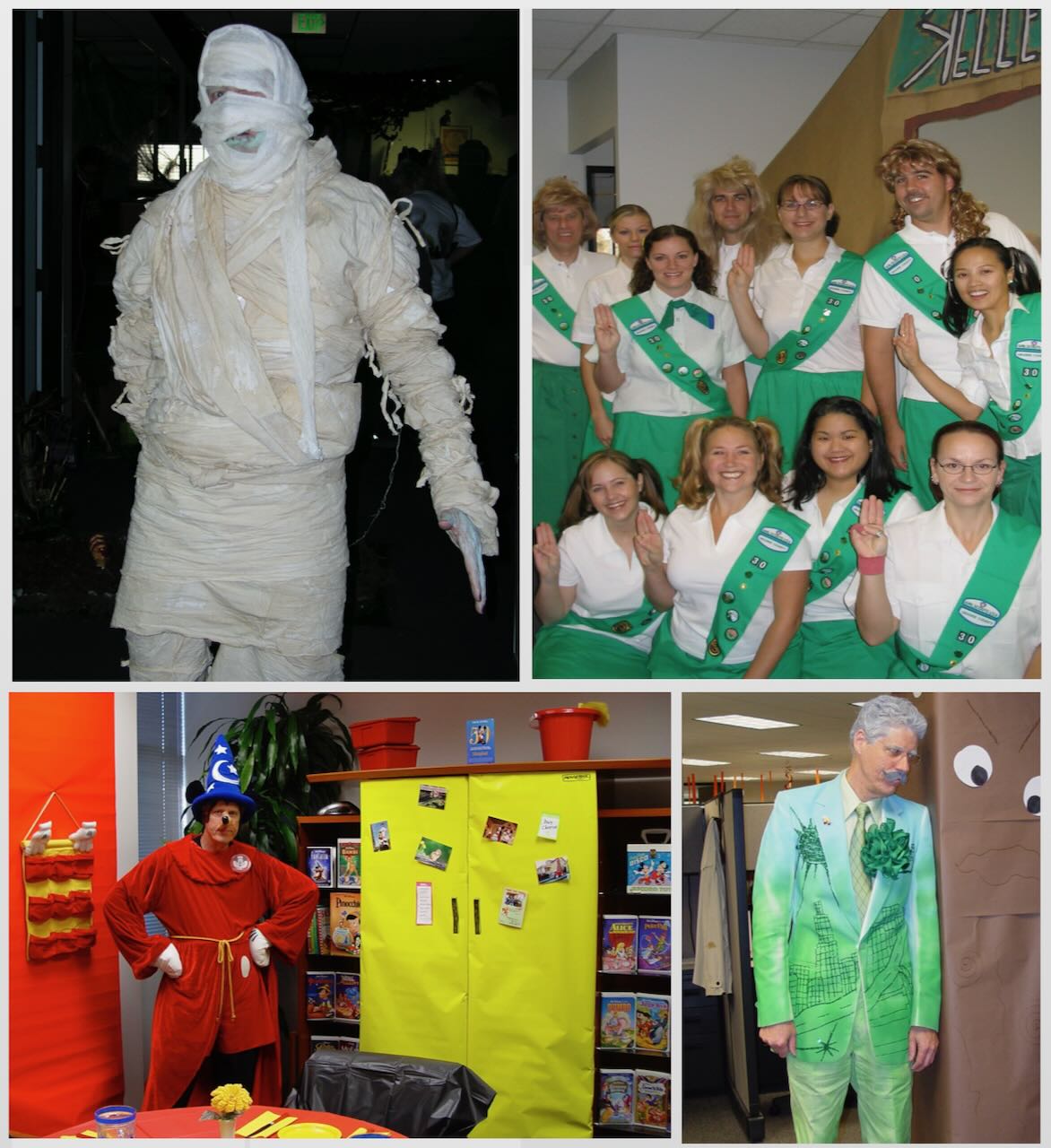
We did add one thing to the Blue Book culture – humor. Our H.R. director once told me that whatever else I did at KBB, I would most be remembered for making Halloween a major event. She was probably right. I encouraged every department to develop a theme and each employee to dress up for the day. It really seemed to bring people together. I did my part as the Mummy, Mickey Mouse, the Wizard of Oz, and even a Girl Scout.
Part 6: The bubble bursts and Internet giants go down. Will the gamble still work?
2000
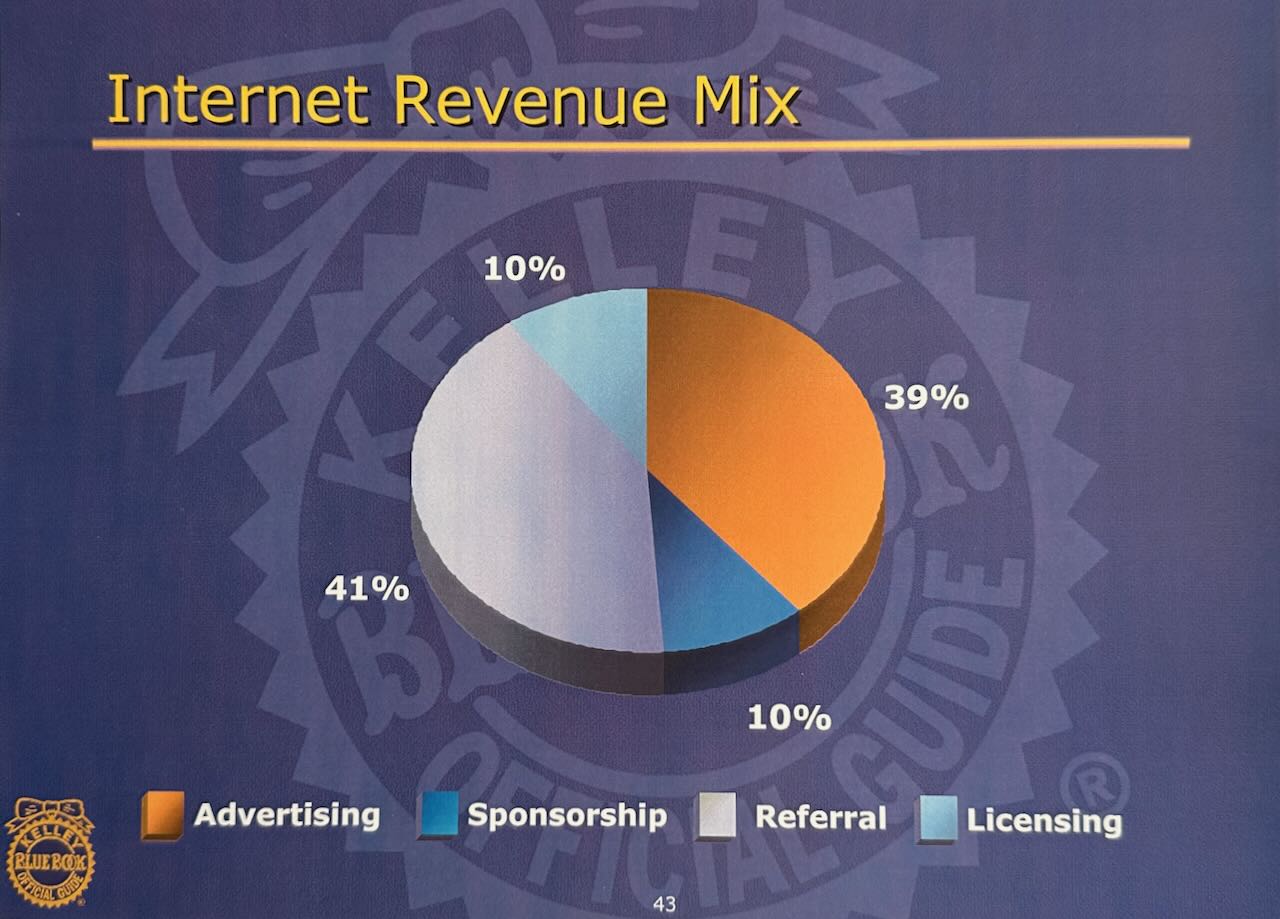
The strategy to give away our products to capture market share was working. In 1996, we delivered 20 million pricing reports to consumers. In 2000, we delivered 250 million. We were also sending 1.5 million leads each month to partners and dealers. In 1997, kbb.com’s net revenue was less than $.5 million. In 2000, net revenue was about $20 million. Maybe more importantly, compared to most Internet sites that were losing money, our operating profits were around 65%! The mentality of “do more with less” at least produced great financials.
It was also a good time to have diversified revenue streams. It happened mostly out of necessity, as we still made our pricing free to consumers and had to scramble for creative ways to make money from the industry. That Internet revenue mix also provided some protection for what happened next.
2000 was known as the year the Internet bubble burst over inflated valuations. The NASDAQ crashed as most dotcoms failed to come close to reaching their promise. It was the end of pets.com (just 9 months after its IPO), etoys.com, and many more. Even a strong company, Amazon, saw its share price drop from $100 to $7. Remember Blue Mountain Arts selling for $780 million in 1999? In 2001, it sold again for $35 million. In automotive, Autobytel saw its price drop from $40 to below $2. And CarOrder.com, shortly after investing $100 million, went out of business. I guess it was a good time to still be in charge of our own destiny.
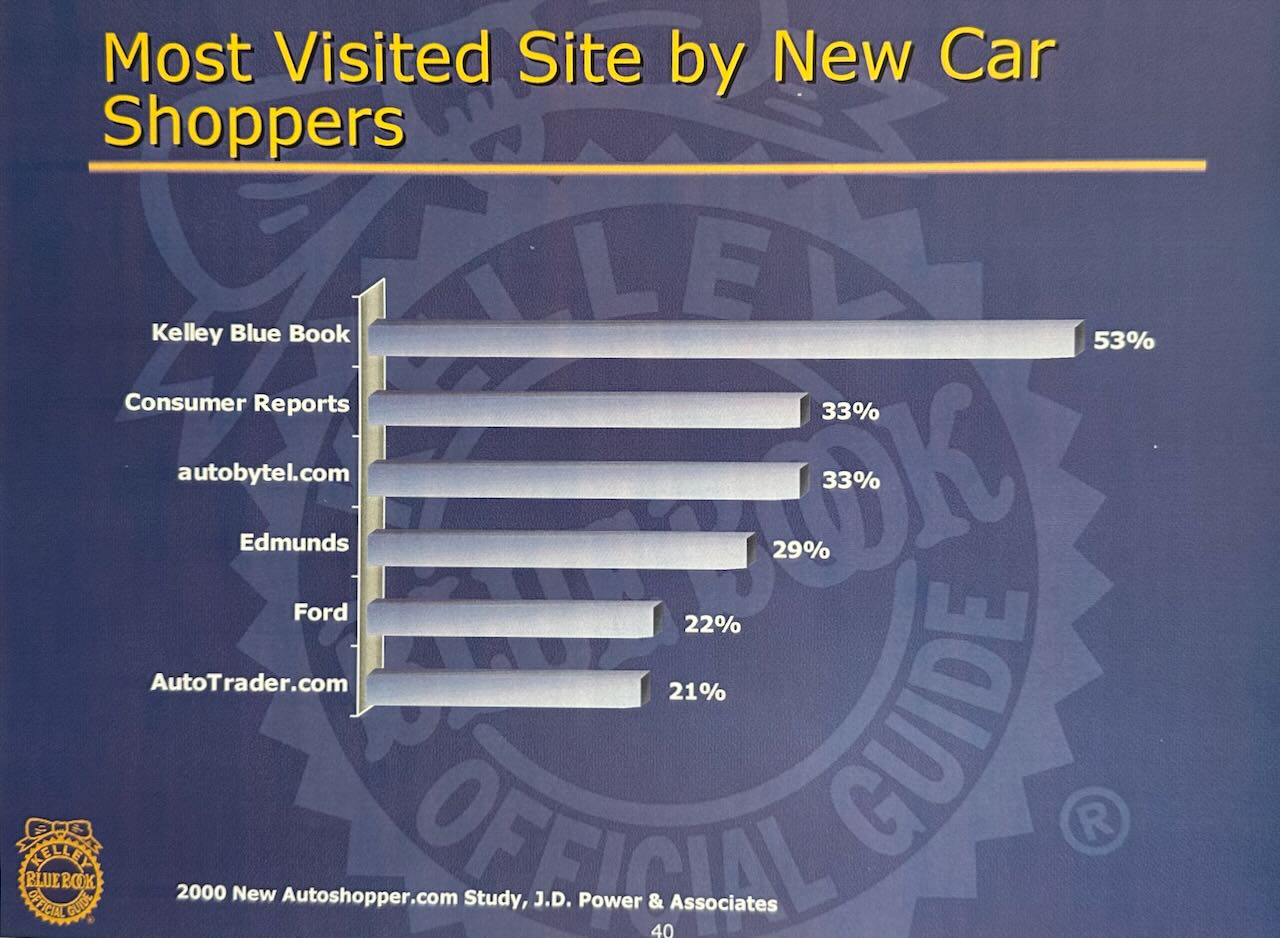
Remember 1995, when dealers almost forced us to shut down kbb.com? By 2000, 54% of all new car buyers were using the Internet to research or purchase a vehicle. And kbb.com was the most visited site by both new and used car buyers. We know, because J.D. Power & Associates developed the New and Used Autoshopper Studies. We blew away all competition in their trusted surveys. 53% of new car shoppers were using kbb.com, with Consumer Reports and Autobytel a distant 33% and Edmunds at 29%. Used car shoppers also chose kbb.com number one, visited by 55%, more than double Edmunds at 21%.
We would go on to win these coveted J.D. Power studies every year, and their credibility really helped us. Because we didn’t have money to run ads, we needed to rely on public relations (really media relations) to get our message out to the industry. I hired an excellent P.R. person, Robin Eckard Eagles, and in turn, Joanna McNally Pinkham (and Brenna Buehler would come later). This small team did wonders making sure the auto manufacturers would think of us as a critical player in the new car transaction, driving our ad business. We also made sure that the top industry media people understood our strategy, including Paul Eisenstein, Mike Roscoe, Cliff Banks, and others. The team would also go on to promote the Kelley Blue Book “Best Resale Value Awards,” which provided recognition that was worth millions in free advertising.
With the Kelleys no longer involved, the trust appointed Paul Johnson to run the company. Paul would manage the business for the next decade until its sale to AutoTrader. Importantly, he also seriously maintained the Blue Book culture of loyalty, integrity, and work/life balance. But I believe one of Paul’s greatest early contributions was convincing Alan Johnson that we needed to invest $10 million to grow the business. For the first time we would be expanding to create new business initiatives, mainly in support of kbb.com. Paul would also push to modernize the data feeds – the algorithms at the heart of the Blue Book pricing engine.
2001
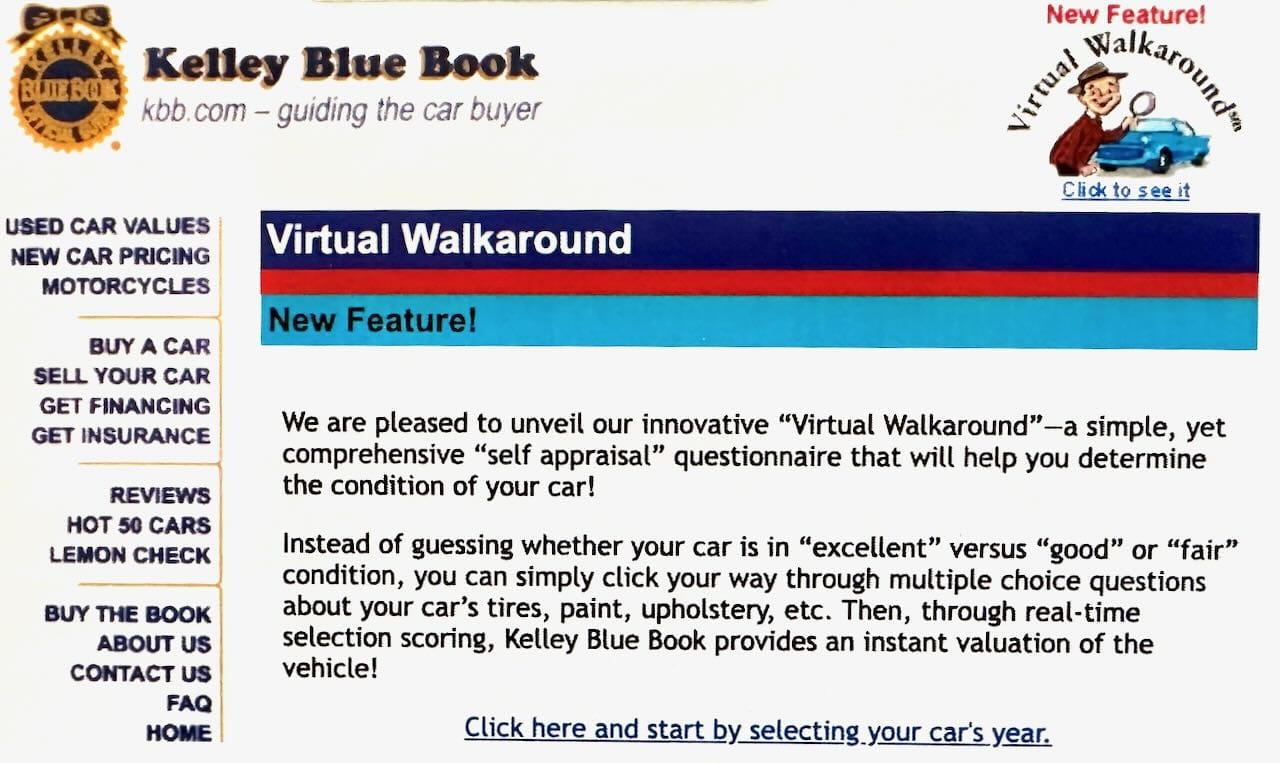
The website was constantly evolving, adding new features that would help consumers in the car buying and selling process. Working with Dick Raines, I added links to Carfax reports that made us both millions. We built our own team of car review experts, including previews of upcoming new cars. We continued to innovate, with decision guides offering side-by-side comparisons, and the “virtual walkaround” that allowed you to appraise the condition of your car. We created kbb.com en Español. And we added a Motorcycles section. In 1995, the home page had 5 features to click on. In 2001, nearly 30. And we tested like crazy. A link called “Buy a New Car” performed better when we softened it to “Online Price Quote.” Then after 20 variations, the ultimate winner was “Free Online Price Quote.”
2002
We had spent several years as part of the DoubleClick network, a low-cost way of selling advertising on our site. One time, I was asked to fly to the Bay area to help on a sales call with the car company, Saturn. I discovered they were really more interested in placing ads just on kbb.com than the rest of the DoubleClick network. We were giving up 40% of the revenue and also not maximizing the value of the site.
I made the decision that we could use the millions of dollars we were now paying DoubleClick to bring the business in-house. DoubleClick had two accomplished digital veterans in the automotive space in Robin Cooper and Bob Mahon. With little hope of prying Bob out of Chicago, I went after Robin to run our business. I eventually convinced her to leave New York. Fortunately, she had a home in Los Angeles, only a few hours from Kelley Blue Book in Irvine. I told her she could work from home while we built sales teams in Detroit and L.A. Robin quickly hired two of the top Internet sales people – Susan Makuch Brown in Detroit and Tim Hand in Los Angeles. I promoted Melissa Chapman internally to build the ad operations group. These leaders, and the people they hired, all fit the Blue Book culture. On January 1, 2002, we were in charge!
For the first time, Kelley Blue Book could really work closely with OEMs (car manufacturers) as partners in new car sales. I appreciated having close working relationships with Tom Peyton at Honda, Steve Kerho at Nissan, and others. They were instrumental in moving the auto industry away from reliance on print and television into the more effective digital marketing. We were already in a 3-year partnership with GM, working with Brian Wines and Leo Drew. It included Blue Book values on their GMBuyPower site, research and data sharing, banner ads on all GM pricing reports on kbb.com, and more.
Of course, there were always a few bumps in the road working with manufacturers. In 2004, I was summoned to Detroit to meet Pontiac’s head of marketing. He was very upset that KBB had put low residual (resale) values on Pontiacs. He said, “The factory gave me a new G6 a few months ago, and this car is flawless.” I thought (but didn’t say), “Do you think they would give you a car that hadn’t been thoroughly inspected and tested?” Anyway, I did say KBB stands by our numbers. He would soon be responsible for Oprah giving away 276 G6s to her studio audience – “You get a car!” Follow-up story: In 2009, Pontiac announced it was going out of business (and you couldn’t give them away).
I had a rule: Auto makers had first right of refusal to run ads on their kbb.com content. If they didn’t buy those ads, they could be “conquested” by competitive makes. GM trucks, for example, ran a lot of ads on Dodge truck pages. I have always been a big believer in contextually relevant advertising. For example, in a travel magazine the ads can be as appealing as the stories. Our site was full of car ads and sponsorships. We were, I think, also one of the first sites to implement behavioral targeting. If you showed interest in a Chevy Silverado on kbb.com, GM would advertise there, but also on a site you visited later.
And I didn’t forget about Bob Mahon. A strong believer in automotive advertising, he left DoubleClick to form his own ad network, the Auto Brand Network (ABN). We strategized about an unserved niche. Kbb.com had unsold inventory – pages we couldn’t sell to the auto manufacturers. Non-endemic advertisers, like State Farm or All State auto insurance, could buy those pages on ABN, which would include kbb.com, Cars.com, Autotrader, and others. It worked. It was shared revenue, but all incremental for KBB.
Part 7: Strong enough to become The Trusted Resource
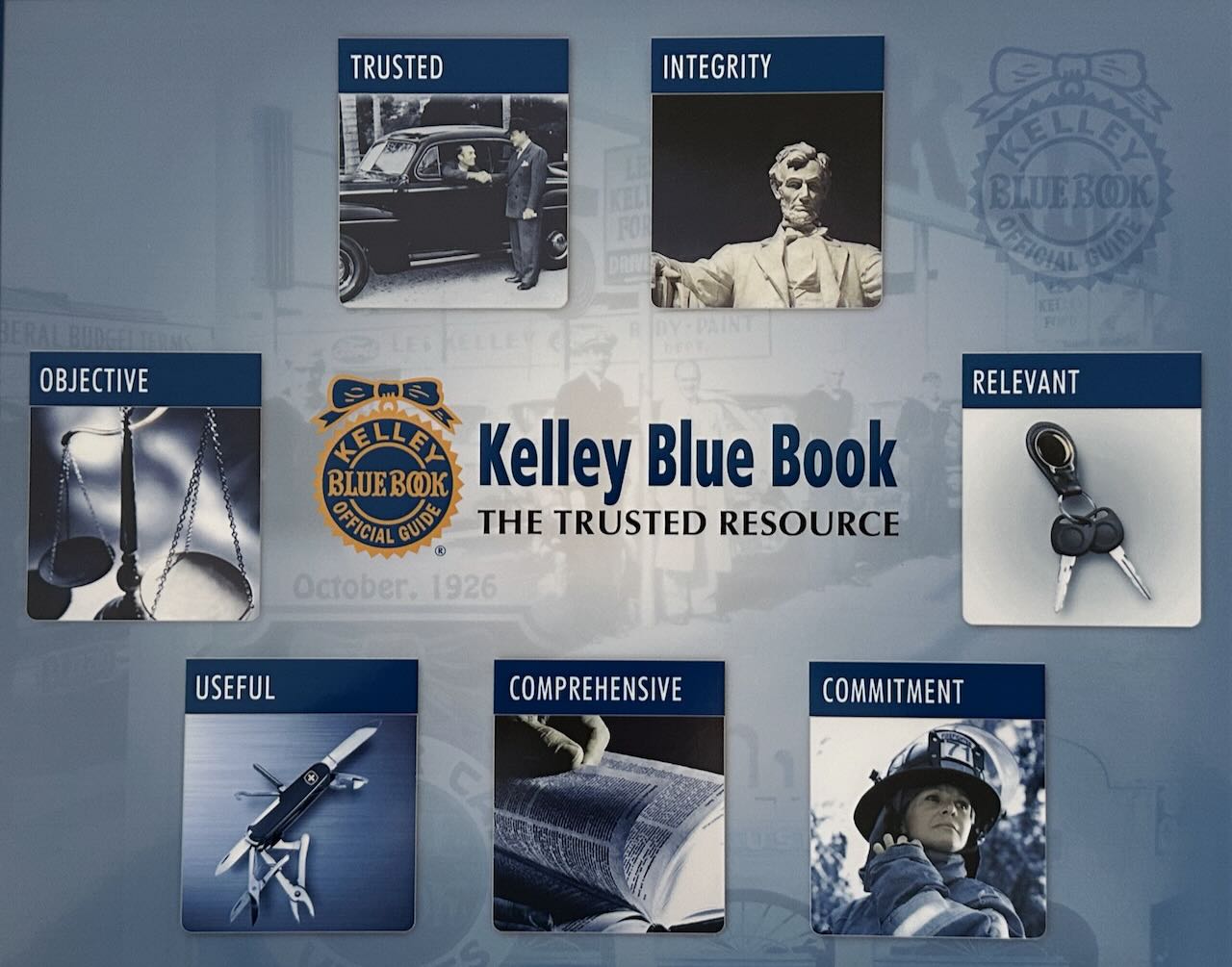
As early as 1998, I gave kbb.com a tagline: “guiding the car buyer.” I wanted to drive home the fact that we were more than just pricing, but also play on our origins as a guidebook. But a tagline should provide something only that company could own. Only BMW can say they are “the ultimate driving machine.” Gradually other websites had begun to copy us. There was even a CarBuyersGuide.com.
It was 2002 and time to change. I gathered Paul Johnson, Robin Cooper, and a whiteboard. We started writing words to describe kbb.com. Reliable. Trustworthy. Dependable. Recognized. Influential. Valuable. Resource. Accurate. Historical. Comprehensive. Official. Confidence. Transparent. Authority. We are, in fact, a Resource. We settled on Trusted to explain why people choose us. Finally, we added The to signify that we are the one and only. The Trusted Resource was born and on the website the next day.
2003
Being number one doesn’t always mean being first to market. Just as Edmunds was the first to show new car invoice prices, they were also first to show what customers were actually paying for new cars. They called it “True Market Value,” not just MSRP or invoice, but a realistic transaction price. Kelley Blue Book also tracked this information, but we worried about backlash from car dealers again. Edmunds, with little dealer business, didn’t have this concern . They paved the way. Competition is good. Once again, we had to tell dealers to count on us to provide accurate information, as we launched New Car Blue Book values in response.
2004
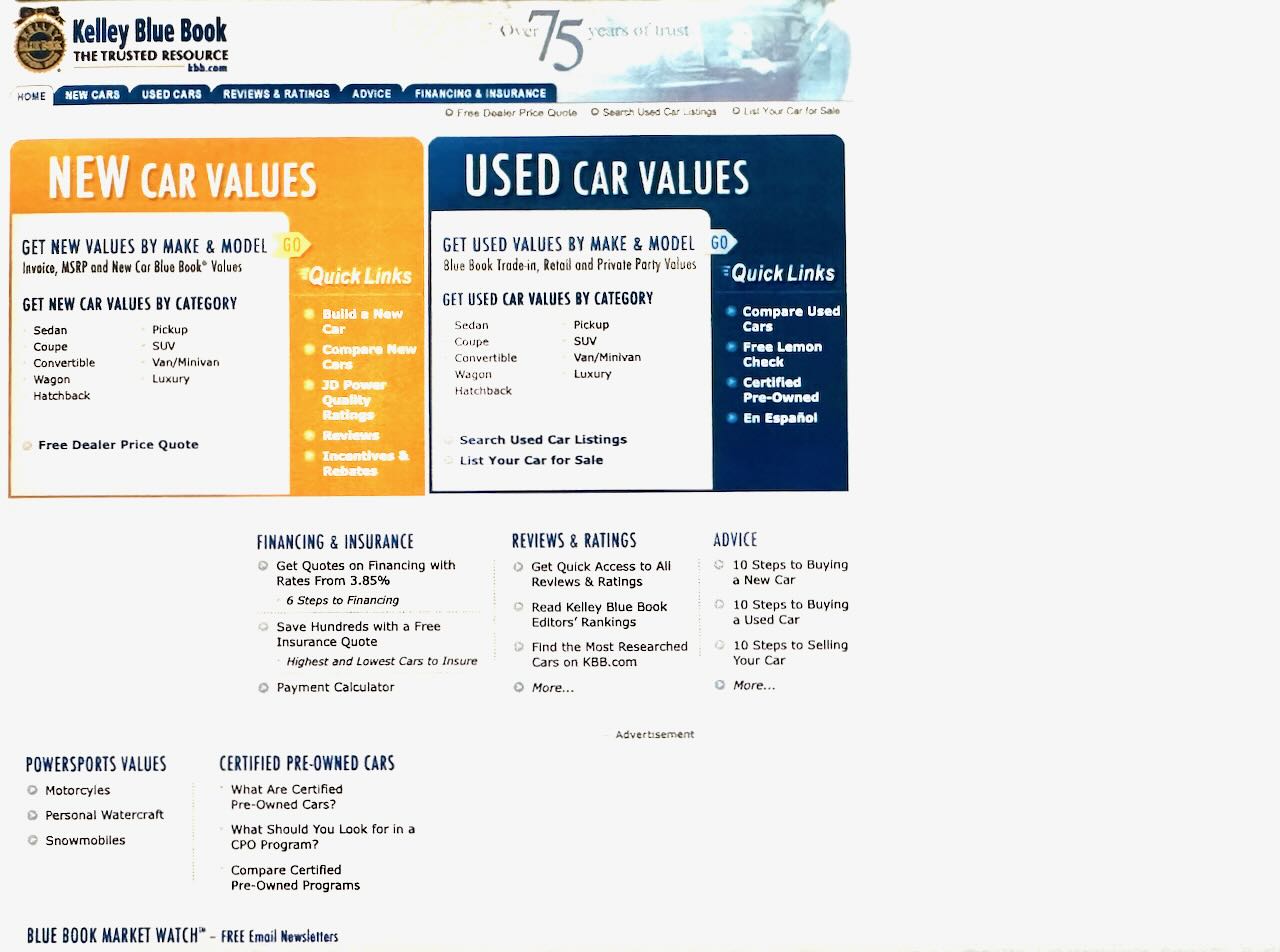
As we grew and were able to add key management, in 2003, I hired Chris Conn to run consumer products and experience. We set out to produce the first major redesign of kbb.com. For the first time we had the money to work with a design firm, industry partners, hold focus groups, run 1-on-1 labs, run Alpha/Beta testing – all the stuff the “big boys” do. When we launched in May, 2004, I was quoted as saying, “With the new design, beginning with the home page, we’ve replaced some clutter with clarity.”
The site did have a cleaner, up-to-date look. But holding those labs and focus groups was an enlightening experience. Notice above how bold we have made New Car Values? Positioned on the left to be the first thing you would see? When we asked users to find used car information, they would navigate expertly. When we asked them to find new car information, many blindly left the site and returned to Google. Being known most for used car values had always been a blessing and a curse.
One story: I met with Jim Farley, who was running Lexus. He said Lexus would pay us $3 million if we would redesign our home page to add a big section for Certified Pre-Owned (CPO) cars. Lexus would sponsor it. He said that Edmunds had already agreed to the same deal. I told him we would test it and let our users decide. Tests were run. Users really weren’t interested. I think Jim was surprised when I told him we were passing on the $3 million. I was just doing the right thing. Follow-up story: We did create a tiny CPO section (see if you can find it above) and still collected the $3 million.
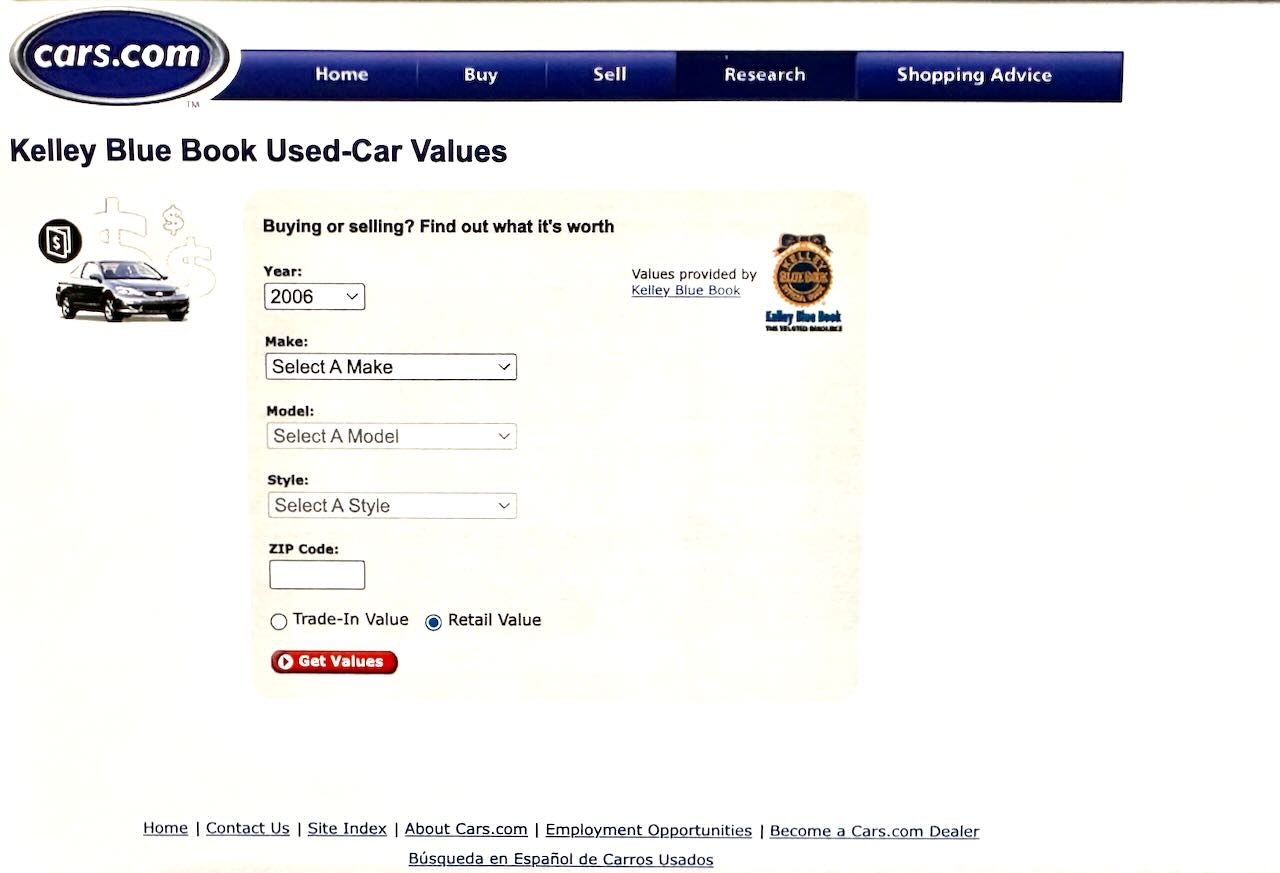
Coca Cola owns the cola market. Kelley Blue Book became the clear leader in automotive pricing. From that low B2B market share in 1991, kbb.com had catapulted us to number one in the B2C world. We stood among the Internet giants! It took years for NADA and Black Book to finally go online, and even then, they served the industry more than consumers. Now, I’m sure it aggravates Coca Cola to see a major venue that sells Pepsi instead of Coke. So, I was somewhat miffed that Cars.com, a good partner in many ways, was using Black Book values on their site. Bill Swislow was my counterpart, and one of their founders (along with Mitch Golub and Alex Vetter). Bill even appeared in ads for Black Book. That was the last straw.
I went to their offices in Chicago and met with six Cars.com managers. I had a proposal. Kelley Blue Book would send all our millions of users interested in buying a used car to what we would call “Blue Book Classifieds, Powered by Cars.com” as a rev share. Plus, any of our users who wanted to sell their car privately, we would send to the “Sell Your Car” section on Cars.com as a rev share. I wanted just one thing in return – replace Black Book on Cars.com with Blue Book. It couldn’t have been easy for Bill to tell Black Book they were being removed, but he knew it was the right thing to do for his business. We would go on to have an excellent relationship between two companies with similar cultures.
2005
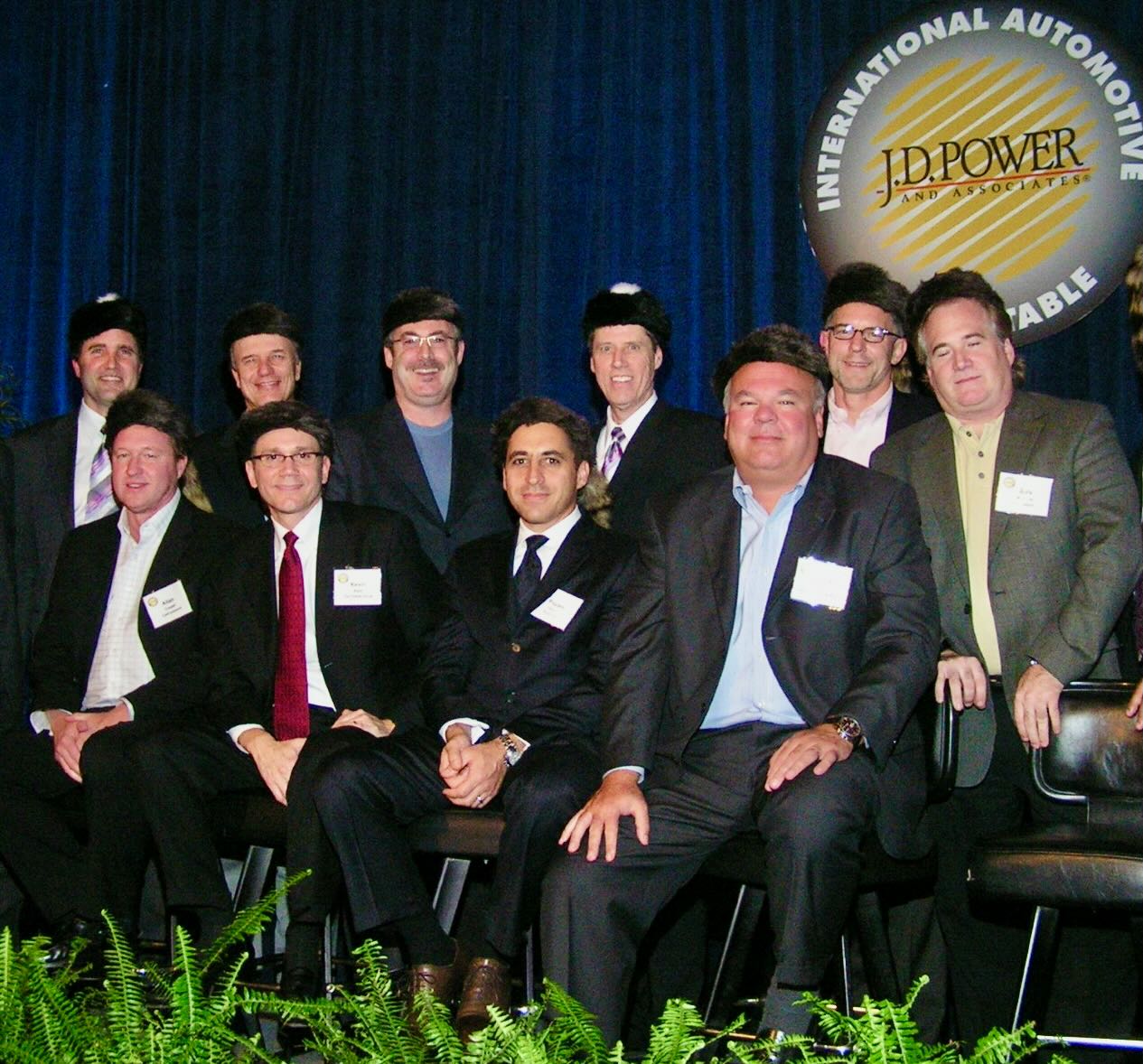
In January, 2005, Charlie Vogelheim left Kelley Book for an executive role at J.D. Power. He would produce their premier conference, the International Automotive Roundtable. 2005 was the tenth anniversary of the automotive Internet, so their big conference commemorated it. At that event, J.D. Power named “10 Pioneers of the Automotive Internet” (above). I was honored to be one. From the back row: Charlie Vogelheim, Chip Perry, Paul Eisenstein, Stephen Henson, John Holt, Gary Marcotte. Front row: Alan Cooper, Kevin Root, Payam Zamani, Brian Reed. Most of the pioneers wore coonskin caps. Charlie and I, who also emceed the event, had to wear skunks. We reminisced about DealerNet, AutoConnect, automallusa, AutoSite, AutoVantage, Calling all Cars, iMotors, CarClub, Cars@Cost, Greenlight, Auto Connection, CarPoint, Driveoff, Carorder, and more. Where did they all go to? P.S. A second event on the 20th anniversary, in 2015, recognized some more people, including Cliff Banks, Jared Hamilton, Mike McFall, Mitch Golub and Bernie Brenner.
Part 8: Kelley Blue Book goes to China
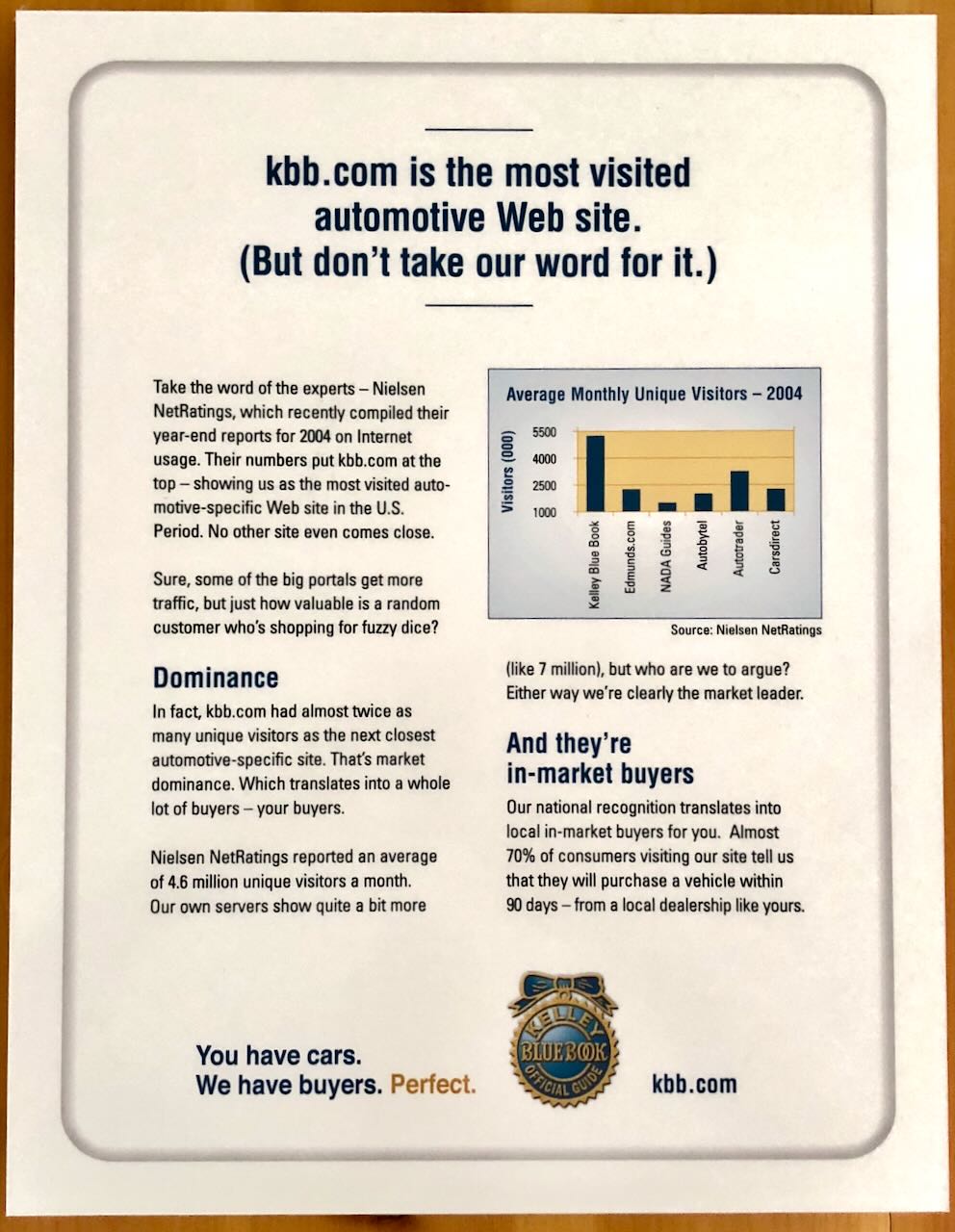
The biggest auto industry conference is the annual car dealers show, with more than 25,000 attendees. New Orleans played host in January, 2005. The show is where the whole industry gathers in one place, marketing, networking, doing deals. I struck deals with Tom Taira (Zag/TrueCar), Mark Rikess, and too many other visionary leaders to name. Over the years, KBB had gone from three of us (Charlie, Tricia, and me) manning a tiny booth to a large operation with dozens of people. Above is a sign from our booth.
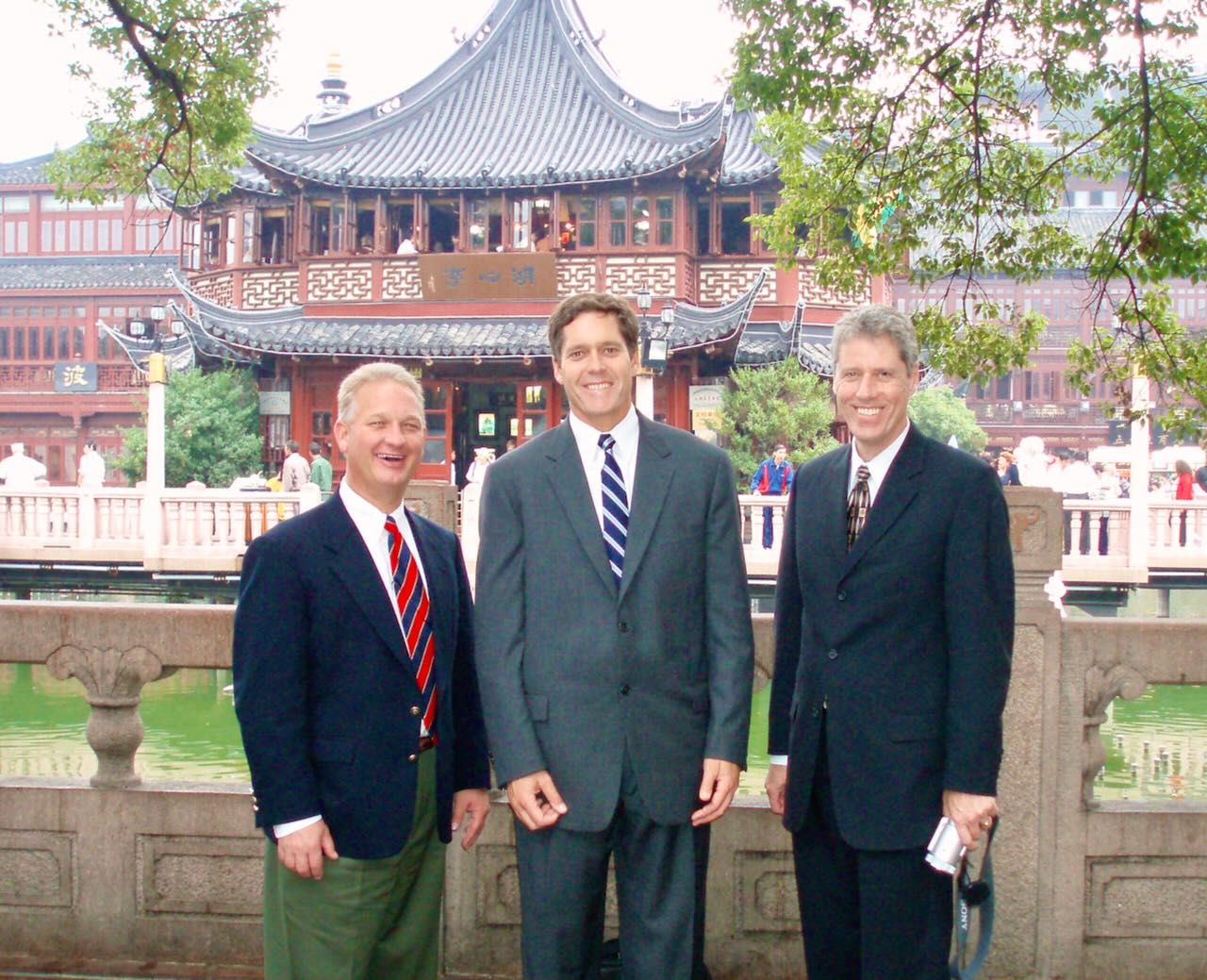
One appointment in New Orleans was a visit from Charlotte Ye, CFO of a similar website to kbb.com, but in China. She was looking for U.S. partners. I was instantly intrigued. The Chinese market was small, but expected to grow exponentially. I invited her to Irvine to meet me after the show. This could be a game-changing opportunity. In October, Paul (now CEO), John Morrison (our CFO), and I traveled to Beijing and Shanghai for meetings hosted by Charlotte. We were blown away by the enormous potential of this market and put a plan together for a small investment in her company. The rest of the KBB management team was excited, as well.
We enthusiastically presented our plan to Alan Johnson, and he said no, “I never want to do business with Red China.” In a lifetime of bad decisions, this was to be his worst.
2006
By 2006, I had added leaders managing growing areas of the business. We hired Rick Wainschel to manage a team of people selling kbb.com-driven market research, primarily to OEMs. Jack Nerad managed a growing team of car review experts and became a spokesperson for automotive trends. After Chris Conn returned home to Chicago, I brought in Tim Nelson from Autobytel to manage the kbb.com product team. And Amy Hedrick, the first person I hired to help me with marketing years ago, continued to rise through the organization to head customer experience and design. I was building a strong team with the goal to replace me.
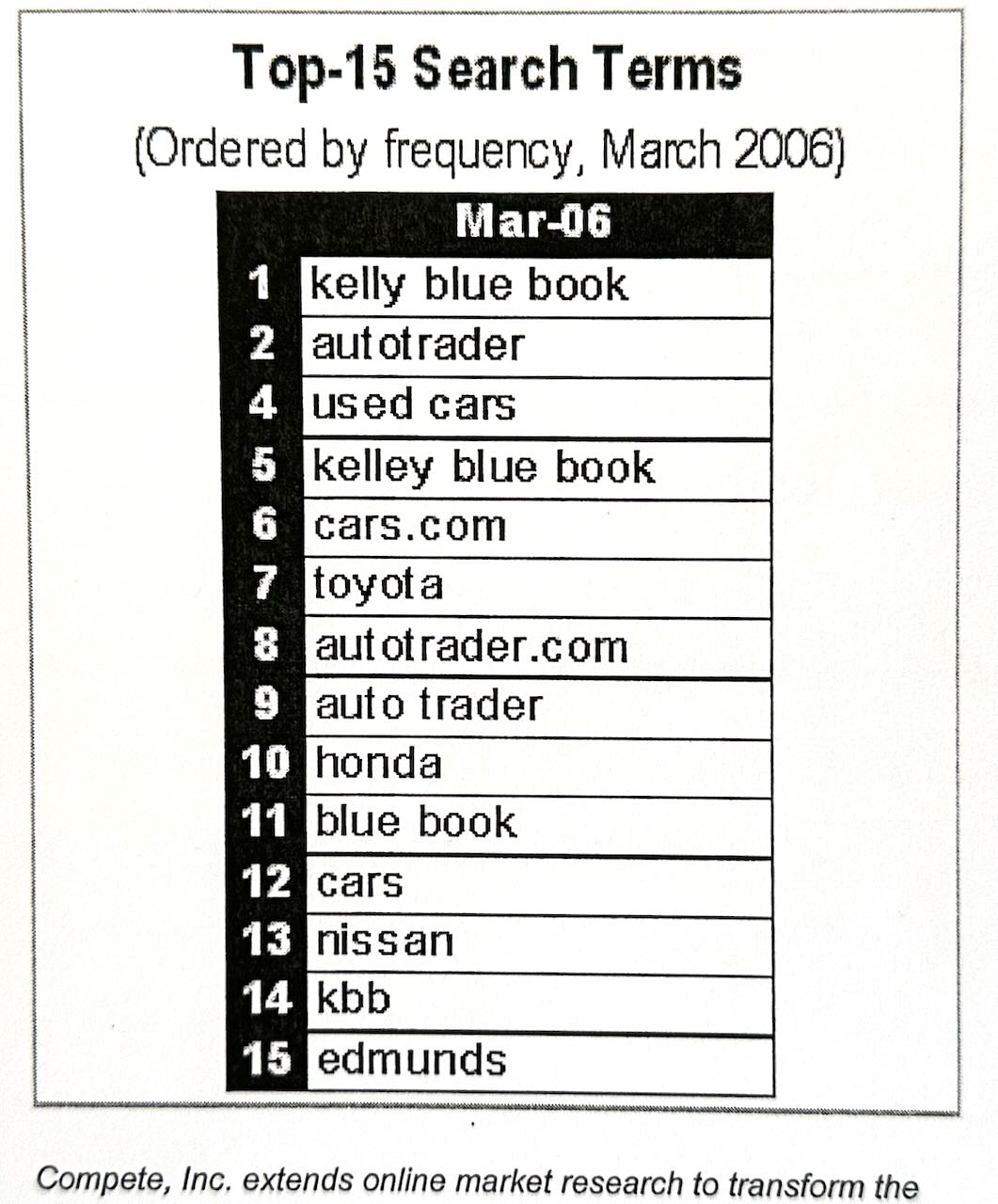
I got a copy of the top 15 search terms in automotive. It validated what we thought way back in 1995. A decade later, the number one searched term was “kelly blue book,” of course, misspelled! We made the list three more times, “kelley blue book,” “blue book,” and “kbb” before anyone even searched for “edmunds.” Of course, there were a lot more people searching by the end of 2006, as 14 million unique visitors a month found our site. The gamble really had paid off. Kbb.com was Kelley Blue Book now, and the company enjoyed a 460% increase in revenues over 10 years.
2007
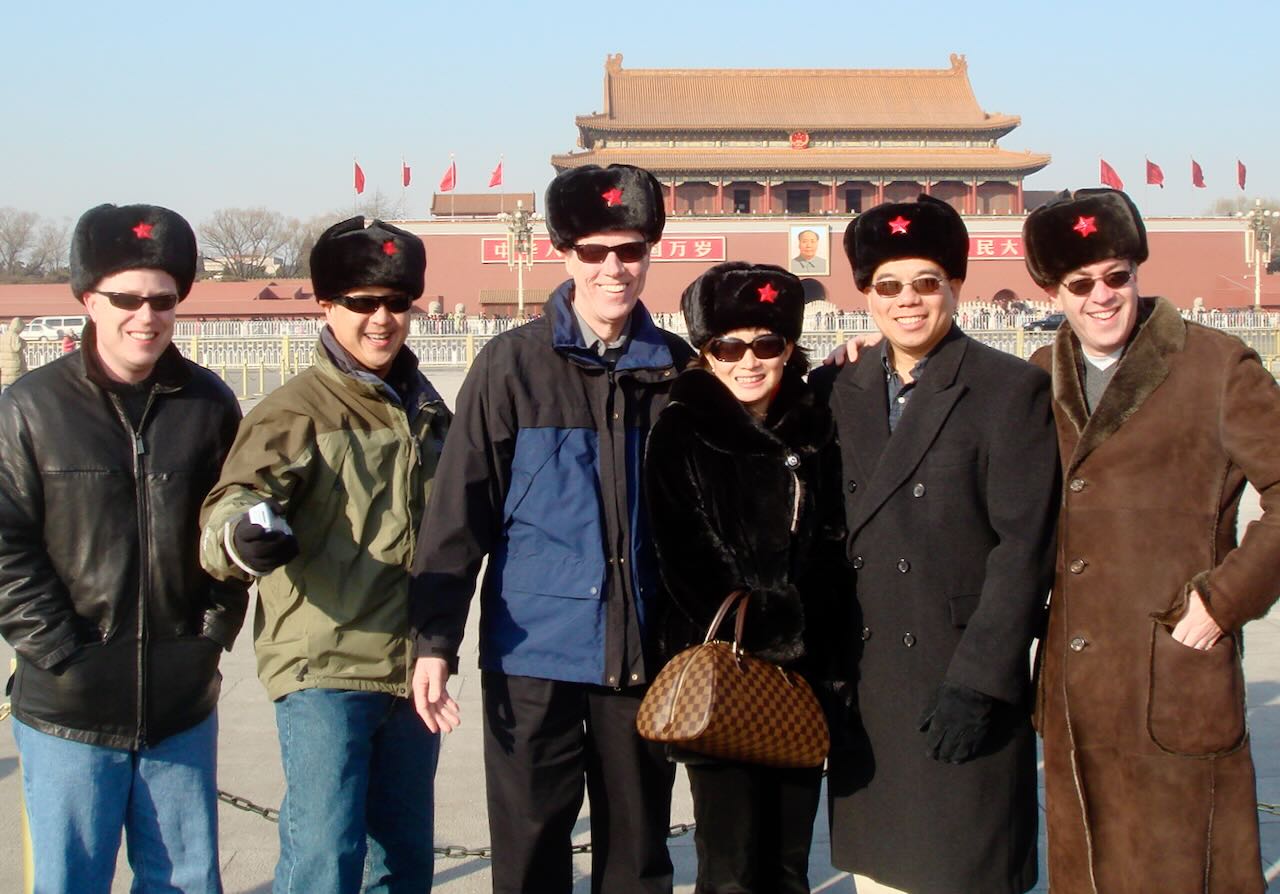
I never gave up on my growing passion for China automotive. In 2006, Charlotte had founded her own company, Webcars, and I visited Beijing two more times that year to consult with them. Justin Yaros, our CTO, then had an idea. It was clear that demand for new features on kbb.com exceeded his organization’s bandwidth. There was also a growing concern over quality assurance (QA). Justin wondered if we could outsource some capabilities to Charlotte’s team in China.
In January, 2007, Justin, Steve Chow (Development), Ed Uy (Project Management), and John Parker (Architecture) accompanied me on a trip to Webcars. A few days later, a handshake at the top of the Great Wall of China began a relationship that was to last through the sale of Kelley Blue Book until 2012. Justin decided I was the best person to manage the new operation, and Steve Chow became an integral part of my kbb.com leadership team.
2008
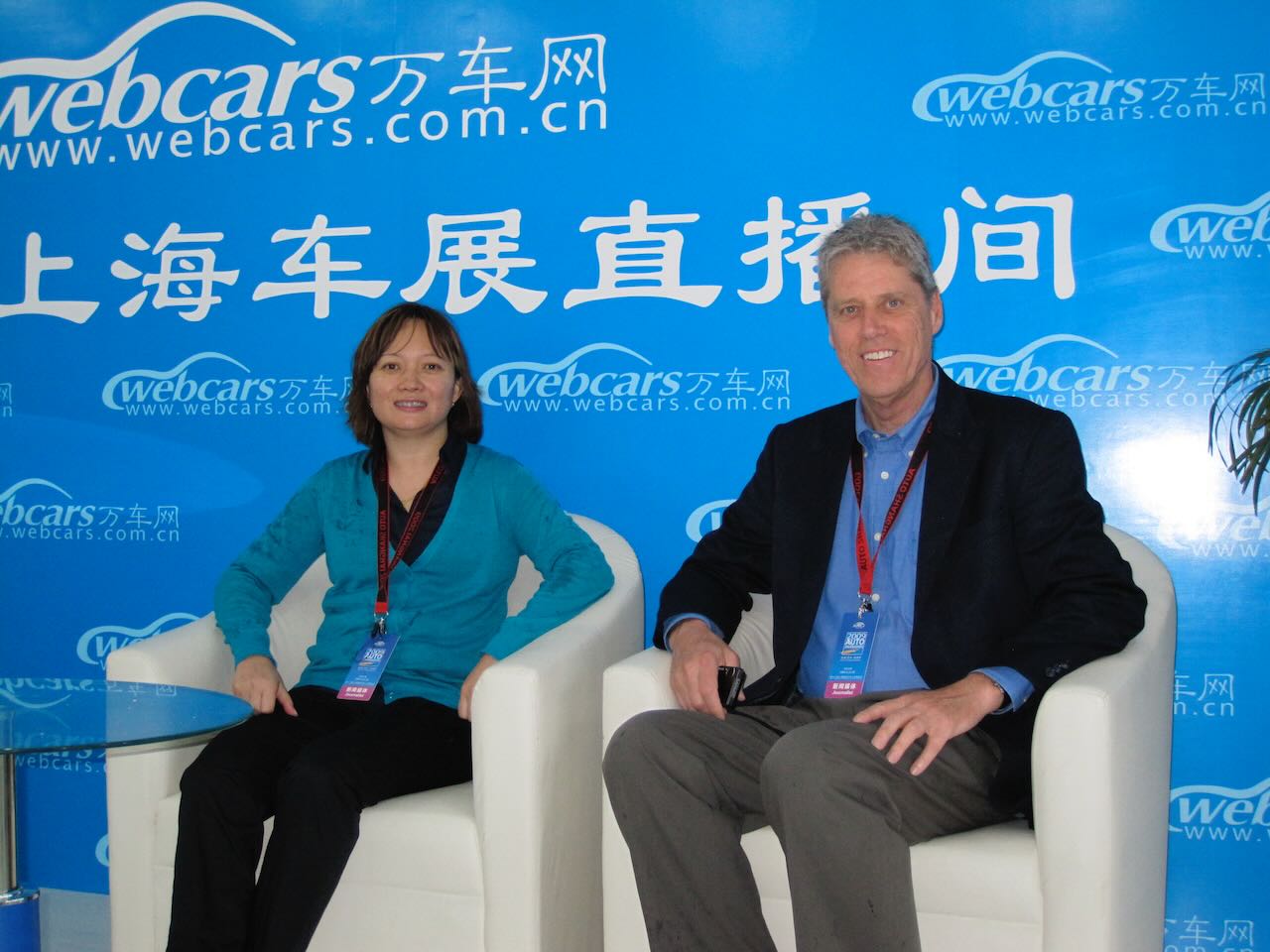
KBB was an early leader in a process called Agile development, and Webcars efforts were making a difference. We effectively bridged the 5,000-mile, 15-time zone gap. Kbb.com did another redesign to accompany many recent features. My favorite was the Perfect Car Finder, an innovative tool where you could search for a new car by criteria important to you.
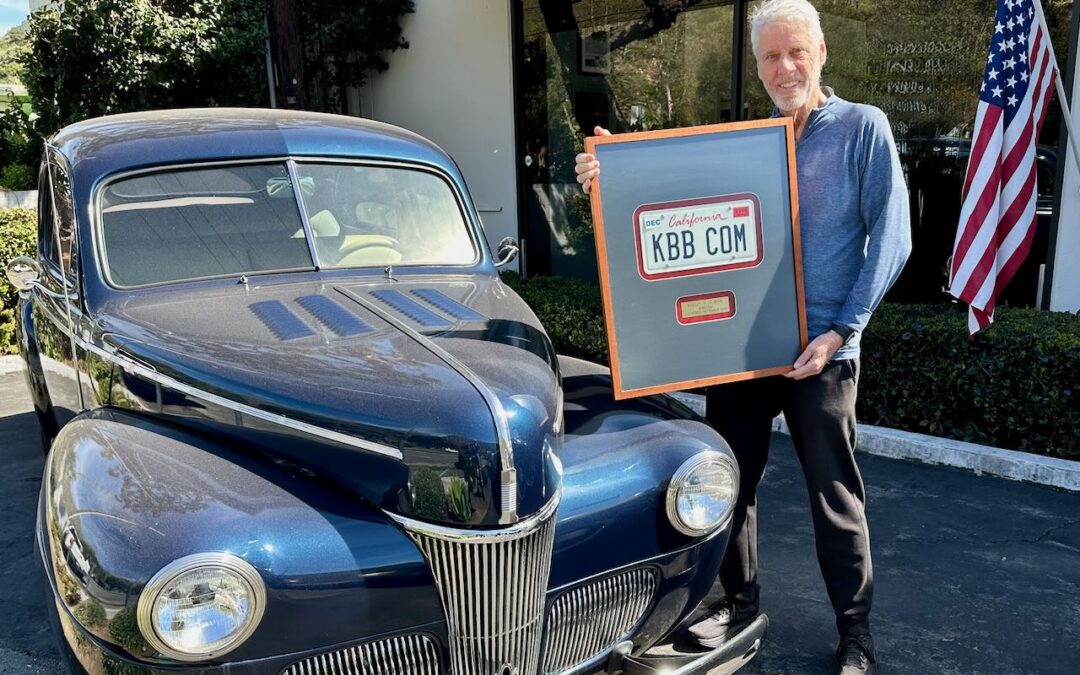
April, 2008 was another milestone. After 17 years, I decided to leave Kelley Blue Book and join Charlotte at Webcars in Beijing. I wouldn’t be entirely leaving the kbb.com world, as I became responsible for the relationship from the China side. In many ways, I worked more closely with the KBB development teams than I had when I was at the company. Five long trips to China and back to the U.S. would become the norm each year. Still, Kelley Blue Book gave me quite a send-off, including the California vanity plate shown at the top of this article, in recognition of being the founder of kbb.com. I’m forever appreciative of a special time at a special place.
2009
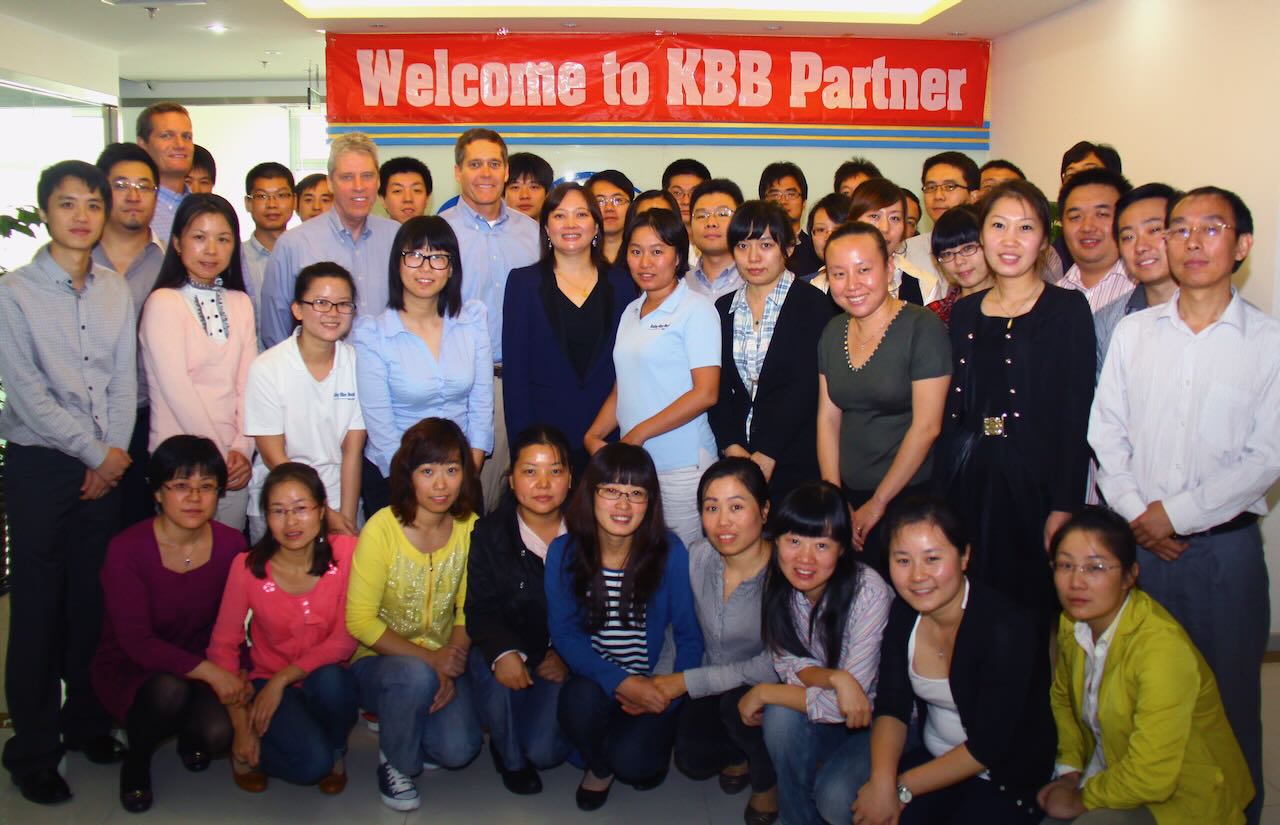
The market crash in late 2008 and subsequent financial crisis of 2009 took its toll on the automotive industry, and Kelley Blue Book was not immune. The company, like others, struggled to reach its goals. Fortunately, the offshoring efforts in China were saving kbb.com a lot of money, so development and QA in Beijing actually accelerated. With the continued confidence and support of Paul Johnson, Justin Yaros, and John Morrison, Webcars would grow to nearly 50 people working on kbb.com. As part of a true international partnership, Charlotte and I would proceed to host KBB teams in China some eleven times.
Under Paul’s leadership, KBB continued to follow the digital course and would come through this crisis. Others, notably Finbarr O’Neill at J.D. Power, were heavily criticized for staying with old methods and not embracing the digital reality.
John Morrison also gets some credit here. You may remember that GM and Chrysler both declared bankruptcy, requiring a government bailout. Kbb.com had a significant $75 million in receivables from advertising owed to the company. John somehow got KBB put on the list of critical suppliers that were first in line to be paid. That helped immensely.
Part 9: The Internet powerhouse is sold
2010
Kbb.com had weathered another crisis and was still number one; and with more than 500 employees, stronger than ever. The trust decided in 2010, it was time again to sell. This time the sales transaction was handled professionally. It involved major investment banks, with J.P. Morgan representing Kelley Blue Book. So, the company known as Kelley Kar Company in 1918 and Kelley Blue Book in 1926, was no longer independent, becoming a new member of the AutoTrader family.
This is largely where my untold story of kbb.com ends. Decisions in 2011 and beyond were no longer made by the trust or by in-house executives, who were all replaced in a year. Kbb.com lives on as the leading destination for automotive pricing, but the story continues from here under a different name.
Epilogue
Cox Enterprises merged its brands, including Autotrader and Kelley Blue Book, under the umbrella, Cox Automotive, today a major player in the automotive landscape. Most of the people I have mentioned in this story are either comfortably retired or have gone on to successful careers elsewhere. For example, Steve Chow and Ed Uy became executives with PADI, the global organization for divers. Paul Johnson became a board member at Cedars Sinai and Board Chairman at Huntington Health. Charlie Vogelheim became both a grandfather and a successful speaker at industry events. Charlotte Ye and Stephen Henson were married in 2018 and have residences in Orange County, California and Beijing. And the Internet really did transform lives.
Years later, I still can’t think of another company that took the strategic gamble to transform itself from a small B2B, give away its product line for free, and become a B2C powerhouse. Do you have your own perspective to add to the untold story of kbb.com? Please feel free to comment at the bottom of this article.